
In 2026, the digitalization of customer services is accelerating significantly, and automation is becoming a lasting part of customer journeys. In this context, it is relevant to question the role of visual IVR.
This evolution does not run counter to customer expectations. Digital channels and self-care solutions are not perceived as obstacles. On the contrary, they are widely adopted, particularly when requests are simple, urgent, and involve little emotional load.
Behind this adoption, expectations are clear and pragmatic. Customers want to access the information they are looking for quickly, at the right time, without having to repeat their request or switch journeys along the way. When these conditions are met, automation is naturally accepted. It integrates seamlessly into the experience and addresses a very concrete need for simplicity and efficiency.
It refers to all the processes that enable a customer to obtain the information they are looking for without human intervention, for example without needing to interact with an agent.
These automated support systems are available 24/7 and handle common requests autonomously. Their implementation makes information easier to access, reduces the workload on support teams, and limits phone queue congestion, while maintaining continuity of service for customers.
To automate customer service, several types of tools can be used. Some are designed to understand the customer’s intent and the context of their contact in order to route them to the appropriate channel, whether automated or human. Others intervene directly in the response, through conversation or guided assistance. In most cases, these solutions rely on artificial intelligence (AI) systems specifically trained for customer service use cases.
Voicebots handle customer reception on the phone channel. They invite callers to express their request in natural language, then either provide an autonomous response or route the call to an agent or to another channel, where the customer is immediately taken care of.
IVRs (Interactive Voice Response systems) also welcome customers by phone. They make it possible to qualify the reason for contact through a guided journey and to route the call either to a self-care solution or to an agent, depending on the nature of the request.
Visual IVRs are a natural extension of traditional IVRs. The customer is first welcomed on the voice channel, then invited to switch to digital. They receive a link on their phone (via SMS, RCS, or WhatsApp) that gives them access to an interface tailored to their situation.
Among these interfaces are knowledge bases or dynamic FAQs. They bring together written, structured answers organized by keywords and contact intents. Accessible through natural language or search, they are available across the company’s digital touchpoints, such as the website, the app, or the customer portal. They can be used both by customers in self-service and by agents to deliver consistent and fast responses.
Next-generation chatbots, or AI agents, make it possible to simulate a written conversation in natural language. They can respond directly to the request or redirect the customer to another resolution channel, human or automated, depending on the context.
Visual IVR naturally stands out as one of the key tools for customer service automation. Its specificity lies in its ability to shift a journey initiated on the voice channel to digital without disruption. This continuity makes it possible to move beyond siloed organizations and deliver clearer, more consistent journeys, regardless of the entry point.
For the company, visual IVR offers several advantages:
For end customers, the benefits mainly relate to the experience:
Within an automated customer service environment, visual IVR therefore plays a central role. It makes it possible to both qualify the intent behind the contact and guide customers toward the most appropriate response or channel. By bridging voice and digital in both directions, it helps create smoother, more coherent customer journeys.
To assess the effectiveness of an automated customer service, it is generally measured by the proportion of interactions handled without human intervention compared to those that require support from an agent. This comparison helps determine the actual level of self-care usage.
It is also useful to look at a very concrete aspect from the customer’s perspective: did they get their answer at the first point of contact, or did they have to restart their journey elsewhere? The faster and more direct the resolution, the simpler the experience is perceived to be. This is why the level of effort required from the customer remains an excellent indicator of satisfaction.
To explore this topic further, you can also read the article: How to measure the effectiveness of self-care?
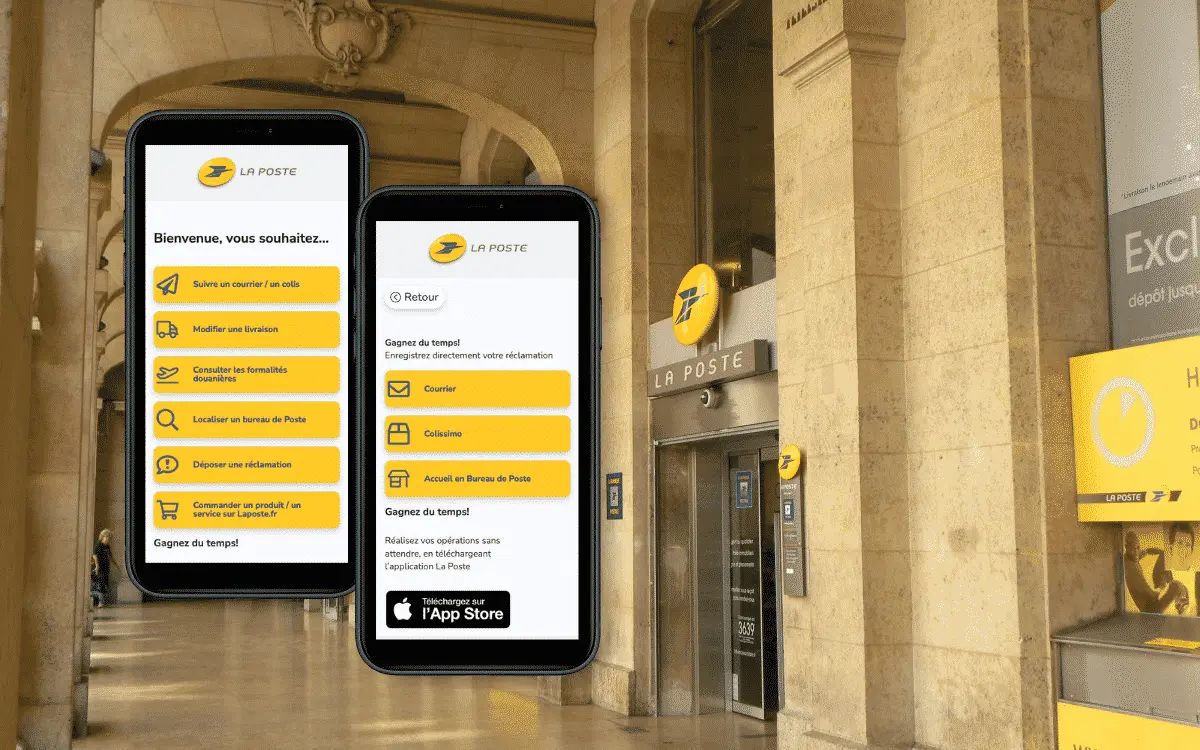
By relying on visual IVR to deliberately route a significant share of contacts toward digital and automated channels, La Poste was able to significantly improve its reachability. More than 70% of requests were handled through digital and automated solutions, enabling the organization to become fully reachable while offering smoother customer journeys.
"DialOnce offers a real solution! When customers call the corresponding number, they can finally get an answer to their query by being redirected to the application. Today, we have a complete solution that brings us real added value!"
Raphaël Colas
Head of Customer Satisfaction & Projects, Quality Department, La Poste