
In recent years, the insurance sector has seen a shift in how artificial intelligence is used. After an initial phase focused on chatbots and isolated task automation, a more comprehensive approach has emerged, built on the orchestration of specialized AI agents.
The principle is simple: multiple specialized AI systems collaborate, share context, and act in a coordinated way within the same process. Each agent operates at a specific stage with a clearly defined role. This structure makes it possible to handle complex situations such as claims reporting and follow-up with greater consistency and speed.
However, this promise does not rely on technology alone. It depends above all on the quality of orchestration and the ability to make AI agents, data, channels, and human interactions work together seamlessly to ensure operational consistency across the entire organization.
Imagine a team of specialists working together on an insurance case. Each has a specific area of expertise: one assesses risk, another verifies documents, a third calculates premiums, and another detects potential fraud. A multi-agent AI system replicates this model.
Instead of relying on a single artificial intelligence to handle everything, multiple AI agents are deployed, each specialized in a clearly defined role and working collaboratively.
The strength of a multi-agent approach lies in this cooperation. Agents share context, pass along relevant information, and intervene at the right moment in the customer journey. The system operates like a coordinated team rather than a standalone tool. For example, if a fraud detection agent identifies something suspicious, it immediately alerts the others, who adjust their analysis accordingly.
This model transforms the way artificial intelligence is designed. Rather than attempting to build a single, general-purpose AI capable of doing everything, the focus shifts to a structured set of specialized agents, organized to solve a problem end to end.
In insurance, processes are complex, data is abundant, decisions are regulated, and interactions are frequent. A multi-agent system brings greater clarity to these workflows by distributing responsibilities across several intelligences and ensuring continuity throughout the handling process.
A multi-agent AI system becomes more effective as soon as the problem goes beyond a simple task. Insurance is a clear example. Customer journeys are long, rules are numerous, and decisions must rely on diverse data sources. A single AI model quickly reaches its limits in this context.
A multi-agent system distributes the workload. Each agent focuses on a specific function, improving the overall quality of processing. This specialization becomes even more powerful through the continuous sharing of context. Agents exchange information in real time, do not start from scratch at each step, and build on historical data to move the process forward without losing information. Where a traditional AI model typically follows a predefined scenario, a multi-agent system allows multiple decision logics to coexist. The journey adapts to the situation, the level of urgency, or the customer profile. If one agent encounters a complex case, it can consult others, much like a human team collaborating on difficult files.
A multi-agent approach also makes it possible to handle multiple dimensions in parallel. One agent can assess risk while another checks compliance and a third prepares the response. Processing time decreases, and decision reliability improves.
Finally, this model is more robust over time. New agents can be added without rebuilding the entire system. The architecture evolves progressively, in line with business needs and emerging use cases.
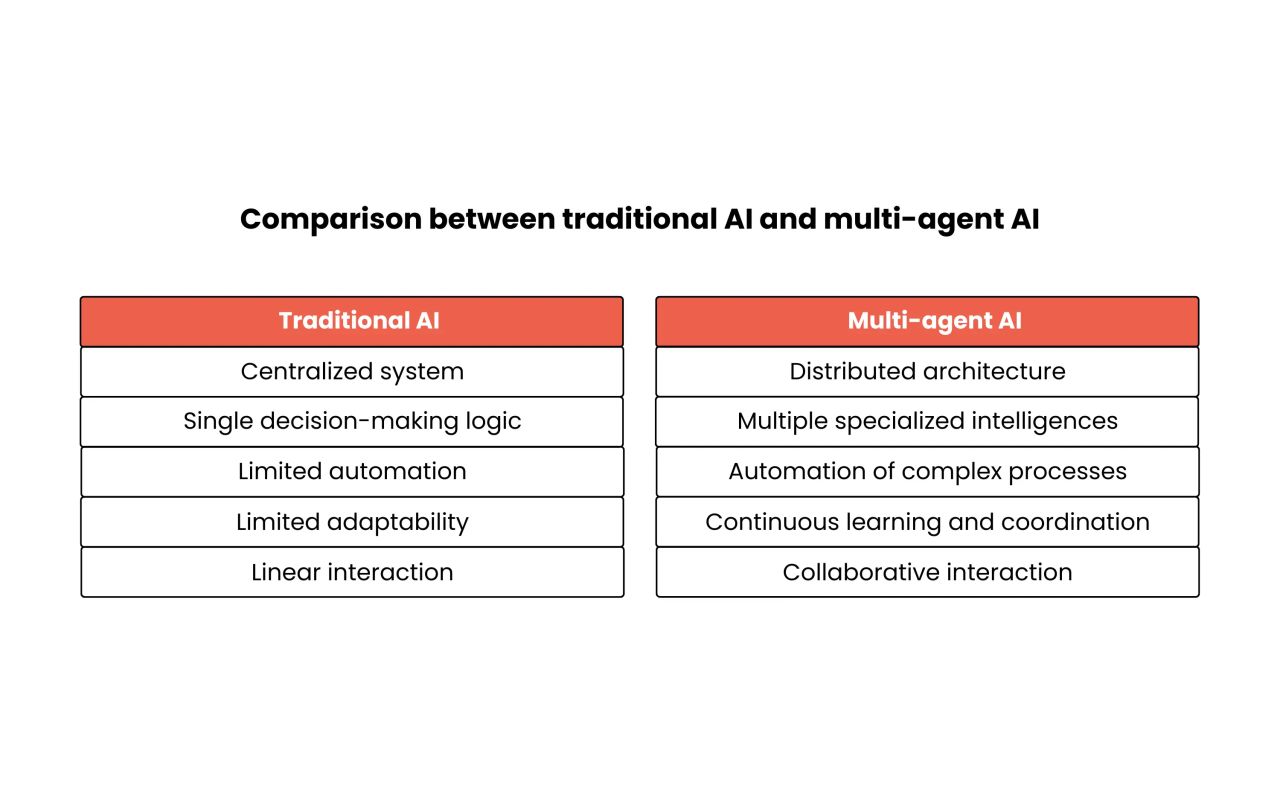
The concept of multi-agent AI is often associated today with agentic AI. The two ideas are closely related, but they do not refer to exactly the same thing.
A multi-agent system primarily describes an architecture. Several specialized agents collaborate, distribute roles, and intervene at different stages of a process. The objective is to organize the work between complementary AI systems in order to handle complex situations in a coordinated way.
Agentic AI, on the other hand, refers more to a mode of operation. It is based on an AI agent’s ability to understand a goal, plan actions, use tools, adjust decisions according to context, and learn over time. The focus is no longer only on coordination, but on the capacity to act autonomously.
Multi-agent AI is concerned with how multiple intelligences are structured to work together. Agentic AI focuses on how an intelligence acts, makes decisions, and adapts.
In practice, many current projects combine both approaches. They rely on orchestrated multi-agent architectures that integrate varying levels of autonomy and adaptability. However, most large-scale customer service deployments still operate primarily within a multi-agent logic. Agentic AI represents a direction in which the market is gradually evolving, with early concrete use cases, but it is still maturing in enterprise-wide implementations.
Managing a claim requires understanding the situation, collecting evidence, qualifying the case, applying contractual rules, communicating with the policyholder, and tracking progress. A multi-agent system distributes these different tasks across several specialized intelligences, each intervening at the right moment.
One agent focuses on understanding the case. Another organizes the information and checks that nothing is missing. A third applies business rules and prepares the next steps. The file is therefore built progressively in a more structured way. Teams receive information that is already organized and directly actionable, without having to start from scratch.
In insurance, requests come from multiple contact points (phone, email, chatbot, customer portal...) and in very different formats. A multi-agent system acts as an intelligent entry point. It analyzes the request, understands the intent, and quickly assesses its priority.
One agent identifies the topic. Another evaluates the level of urgency. A third routes the case to the appropriate journey or team. The request is qualified from the outset, avoiding unnecessary transfers and delays. The system can handle large volumes while maintaining clear prioritization and overall consistency.
Fraud is not always immediately visible. It often hides in subtle details, inconsistencies, or unusual behaviors. A multi-agent system makes it possible to analyze these signals from several angles at the same time.
One agent evaluates the declarations. Another compares them with known cases. A third verifies supporting documents. Together, they build a more reliable understanding of the situation. The process no longer relies on a single indicator. Detection becomes more precise, and false positives decrease, while the final decision remains in the hands of specialized teams.
A multi-agent system operates in the background to support teams. It gathers information, summarizes interactions, and highlights key elements.
Advisors can easily access a condensed view of the customer’s history, documents, context, and suggested next steps. They spend less time searching for information and more time advising and making decisions. The human role remains central, but intervention occurs on cases that are already structured and qualified.
Beyond individual cases, a multi-agent system provides a broader view of operations. It shows where cases are progressing, where they are stalled, and which stages take the most time.
Customer service managers can adjust priorities, redistribute workloads, and improve journeys based on concrete insights. The organization gains greater visibility and can adapt more easily to fluctuations in activity.
The value of a multi-agent approach goes beyond simple automation. It addresses very tangible industry challenges such as cost pressure, rising customer expectations, channel proliferation, regulatory constraints, and the significant increase in data volumes.
Each agent operates within a clearly defined scope and contributes to building a case that is more complete, more structured, and more reliable. Information flows more effectively, duplicate data entry decreases, and processing time is reduced.
Multi-agent AI also makes it possible to automate repetitive tasks without making customer journeys rigid. Teams can focus on complex situations, customer relationships, and decision-making. Human resources are used more effectively and positioned where they create the most value.
Responsiveness improves as well. Tasks can be handled in parallel, and the system adapts to context in real time. Responses are delivered faster, journeys become smoother, and policyholders benefit from more continuous follow-up.
Another major impact lies in cross-channel continuity (omnichannel). Requests now originate from websites, mobile apps, email, and messaging platforms. A multi-agent system preserves context and enables seamless transitions between channels. The case follows the customer, not the other way around.
This model also strengthens risk management quality. Analyses rely on broader datasets, cross-checked by multiple agents. Fraud detection improves, decisions are better supported, and anticipating customer behavior becomes possible.
Finally, it provides true scalability. The system can evolve progressively: new agents can be added, new products integrated, additional data sources connected, and new regulatory rules incorporated, without rebuilding the entire architecture.
Insurers gain a more granular view of their operational flows, bottlenecks, and the most time-consuming stages. They can adjust priorities, steer operations more precisely, and improve customer journeys based on concrete, actionable insights.
Multi-agent AI is still a relatively recent approach. It opens up new possibilities, but it remains in a structuring phase and requires significant adjustments within organizations, both technically and operationally.
The first limitation concerns data. These systems rely on continuous information flows from multiple sources. If data is incomplete, inconsistent, or poorly governed, coordination between agents becomes less effective. The quality of outcomes directly depends on the quality of available data and the organization’s ability to structure and maintain it over time. Improving data quality requires a structured governance effort: mapping data sources, defining shared reference frameworks, and prioritizing use cases based on reliable data before progressively scaling the model.
Human oversight also remains essential. Agents automate, accelerate, and generate recommendations, but they do not replace business expertise or decision-making authority. In sensitive situations, particularly in claims settlement or risk management, human intervention is necessary to validate, contextualize, and decide.
The integration of advisors must be considered from the design stage. It is crucial to clearly define when AI makes recommendations and when humans make decisions, in order to avoid gaps in response and ensure secure, controlled usage.
When multiple agents contribute to a decision, it becomes critical to understand the reasoning chain, ensure traceability, and mitigate bias linked to data or models. Trust in the system depends not only on performance but also on explainability. Establishing trustworthy AI requires mechanisms for transparency and auditability. Decision rules must be documented, outputs tracked, and models regularly evaluated to identify biases and secure their use (LLM-as-a-judge). Regulatory requirements further reinforce this need. Data protection, auditability, sector-specific compliance, and decision traceability impose a strict framework. Systems must be able to justify their actions, retain historical records, and adapt to rapidly evolving regulations. Collaboration with compliance and legal teams should begin at the project’s inception to embed traceability and documentation mechanisms from the outset rather than adding them later.
From a technical perspective, integration is often the main challenge. Insurers’ information systems are typically built in successive layers. Enabling multiple agents to interact with these environments requires robust architectures capable of managing exchanges, dependencies, and process continuity. A phased approach is recommended: start with isolated components, test integrations on limited scopes, and then progressively extend the system based on observed results.
Finally, the most significant challenge is organizational. Multi-agent AI is not deployed like a simple tool. It reshapes the way teams work, distribute responsibilities, and collaborate. It requires process adjustments, role redefinitions, and long-term change management. Successful deployment depends as much on team adoption and structured training as on the technology itself.
Multi-agent AI is not simply a technological upgrade. It represents a shift in how insurers design their operations, customer journeys, and internal organization.
By distributing roles across multiple specialized intelligences, insurance companies can handle complex situations with greater consistency, speed, and continuity. Cases are more structured, teams benefit from richer context, and decisions are based on a more comprehensive view of the situation.
This transformation remains gradual. It requires time, adjustments, and increasing maturity in data management, governance, and business practices. However, early deployments already demonstrate tangible impact on operational performance, customer experience, and risk management.
The question is no longer whether multi-agent AI will establish itself in insurance, but how it will integrate into existing models and reshape collaboration between people, systems, and data.