

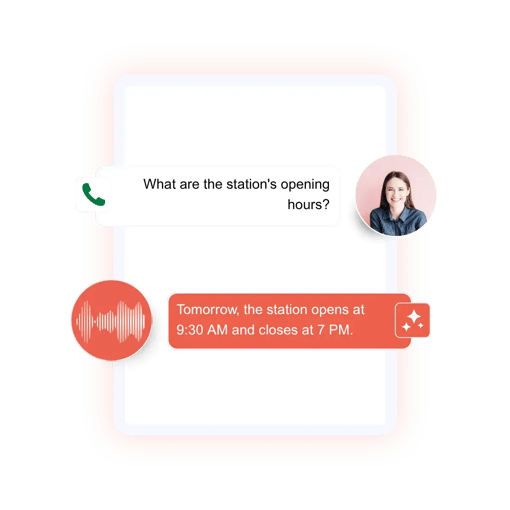
Voice AI agent: automate your customer service with AI
AI voice agents look alike in a demo and differ in what surrounds them: telephony, business tools, data hosting and how results are measured. This guide gives you the criteria to compare them and the questions to ask every provider.
Guide published by DialOnce, publisher of an AI voice agent. The criteria apply to any solution. By Bastien Meaux, Marketing Director. Last updated November 17, 2026. Next review: first quarter of 2027.
A voicebot is a conversational agent that talks by voice, whatever the channel: website, app or phone. A callbot is a voicebot deployed on the phone line. An AI voice agent also understands the request in natural language and triggers actions in the company’s tools. A traditional interactive voice response (IVR) system routes the caller with a touch-tone or voice menu.
Providers do not all use these words the same way. Ask what the solution actually does during the call.
To go further on definitions, read our article on the difference between a mailbot, a voicebot and a chatbot.
The market falls into five families. Each one answers a different starting situation.
| Family | Starting situation | Point of attention |
|---|---|---|
| Voice modules from contact center vendors | You are changing or renewing your contact platform | Dependence on a single vendor, AI engine limited to the one the platform offers |
| Omnichannel conversational platforms | You want the same knowledge base for voice and digital channels | A larger integration project |
| Voice specialists | You want a voice agent quickly, on your existing telephony | One more provider to coordinate |
| Developer platforms | Your technical team builds its own journey | Internal resources for operations and supervision |
| No-code solutions | You configure the agent yourself | Integration with information systems is often less advanced |
DialOnce belongs to the second family, omnichannel conversational platforms.
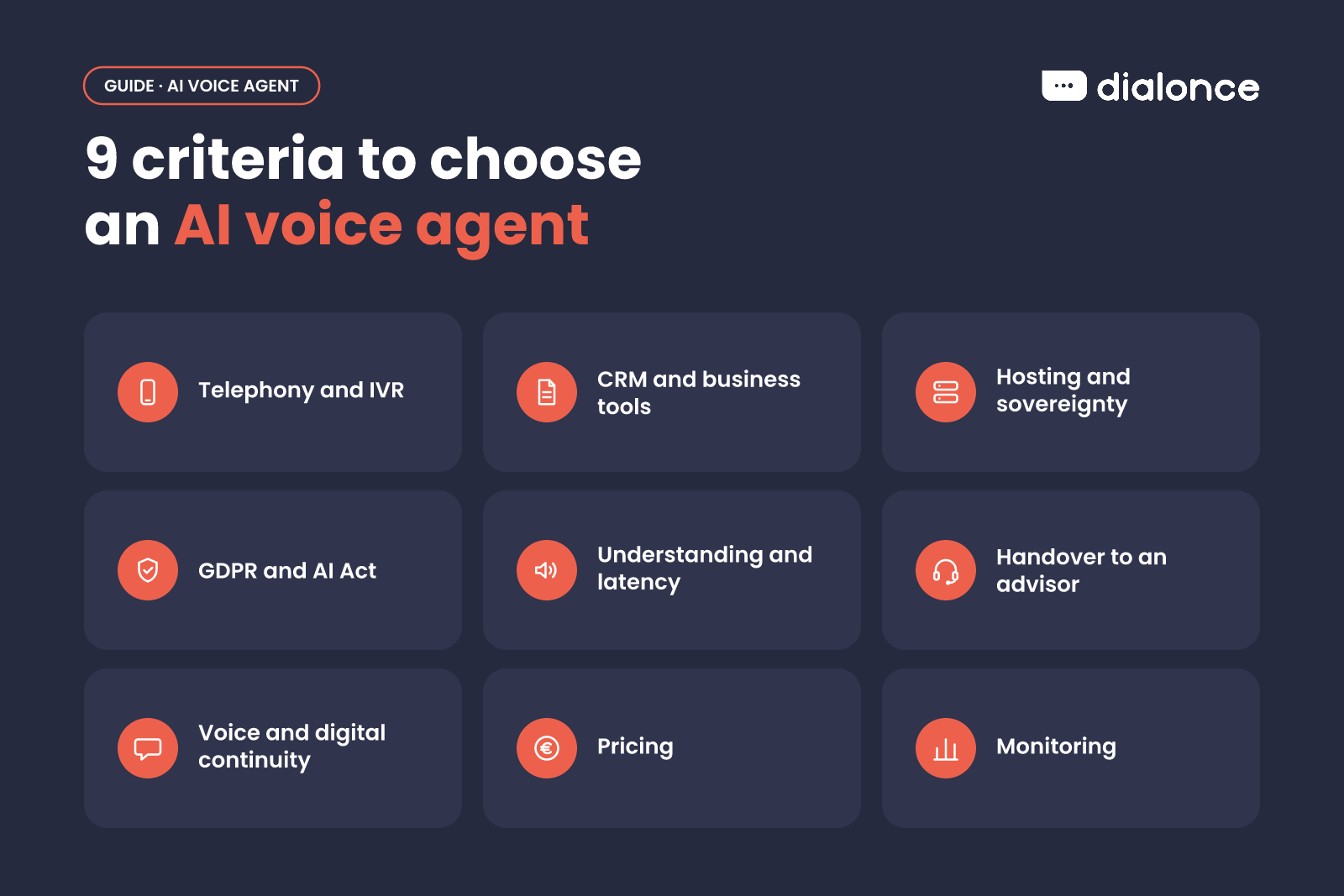
Nine criteria cover the essentials of a choice. For each one, the last column says how to check the provider’s answer instead of taking it on trust.
| Criterion | Question to ask | How to check it |
|---|---|---|
| Telephony and IVR | Does the solution plug into my current telephony, or does it require the provider’s own? | Connection method shown in a demo: SIP trunk (phone line over the internet) or DID (direct inward dialing: a dedicated number that you redirect to the agent) |
| CRM and business tools | Does it read from and write to my CRM during the call? | Native connector for my tool, test of a real write |
| Hosting and sovereignty | Where are recordings and transcripts stored, and which AI subcontractors are involved? | Contract clauses, list of subcontractors |
| GDPR and AI Act | Is the caller told they are talking to an AI, and who configures that message? | Welcome message played back, contract clause |
| Understanding and latency | How does the solution handle accents, background noise and case numbers? | Test on real recordings, measured response time |
| Handover to an advisor | Does the context of the conversation follow the caller? | Handover tested end to end |
| Voice and digital continuity | Can the caller move to an SMS, an RCS message or self-service with the same knowledge base? | Multichannel journey demonstrated |
| Pricing | Price per minute, per contact or per resolution, and what counts as a resolution? | Written price list, contractual definition |
| Monitoring | Which indicators are provided: autonomous resolution, escalation, satisfaction? | Dashboard shown in a demo |
On hosting and sovereignty, read a secure, sovereign, and responsible technology.
For continuity between voice and digital, discover the Vocal Guide.
The right choice depends on call volume, the telephony already in place, the level of regulatory constraint and the technical resources available.
An organization with high call volumes in a regulated sector such as banking, insurance, energy, public services or social housing generally puts the most weight on hosting, integration with its systems and a handover that keeps the context. Voice modules from contact center vendors and omnichannel conversational platforms answer this profile.
A small or mid-sized business that wants an agent live within days will lean toward a no-code solution or a voice specialist, with a less advanced integration.
DialOnce is a French software company that places its AI agent upstream of the contact center and serves large private and public organizations. It states that its AI is designed, operated and hosted in France. The DialOnce AI voice agent connects to existing telephony through a SIP trunk or a DID. It is not suited to a team that wants to configure an agent on its own, in self-service, without an integration project.
DialOnce is a partner of most CCaaS and CRM vendors. To learn more about our integrations, visit the partners page.
Prices are calculated per minute, per contact or per resolution, and the same word covers different realities. Before comparing two quotes, have the provider write down what counts as a resolution and who records it.
Three indicators are enough to steer: the share of calls handled without an advisor, the share of calls handed over to an advisor along with the causes of those handovers, and caller satisfaction. Compare the full cost per request handled, telephony and supervision included, rather than the advertised price.
To prepare the rollout, read our article on the call center voicebot.
Ten questions to ask every provider, DialOnce included.
An agent built on generative AI can give inaccurate information. Limit its answers to a validated knowledge base, restrict the topics it handles and forbid any commitment on sensitive points. A poorly qualified request sends the caller to the wrong person: plan for ambiguous requests in the scenarios, and for a handover to an advisor that is always available, including after several misunderstandings.
Since August 2, 2026, Article 50 of the European AI regulation requires that people be informed when they are interacting with an AI system (source: European Commission). Have the provider specify in writing who configures this welcome message. The data processed (voice, transcript, phone number) also falls under the GDPR: storage location, retention period and any use to train models should be validated with your data protection officer.
A voicebot is a conversational voice agent: it understands a request spoken aloud and answers it, or hands it to an advisor. It is called a callbot when it is deployed on the phone line.
Both understand a freely worded request. The voicebot adds two steps: turning speech into text, then turning the text of the answer back into speech. That is why spoken interactions are more sensitive to noise, accents and interruptions.
No. It handles simple, repetitive requests. Advisors keep the situations that call for listening, expertise or a decision.
Yes. Since August 2, 2026, Article 50 of the European AI regulation requires that people be informed when they are interacting with an AI system (source: European Commission). Have the provider specify in writing who configures this message.
Prices are calculated per minute, per contact or per resolution. Ask for a written price list, the definition of a resolution and the list of what is included (telephony, supervision, updates), then compare the full cost per request handled.
Have the provider define in writing what a resolution is, for example a call that ends without a handover and without a callback in the following days. Specify who records it and from which data.