
Skip to content

Artificial intelligence and customer relations: towards an augmented customer advisor thanks to new AI tools


Artificial intelligence (AI) is gradually finding its place in customer service. Initially seen as a support tool, it is now establishing itself as a true ally for advisors, like a discreet yet ever-present colleague who helps them manage their daily workload more effectively. Step by step, advisors are learning to collaborate with these tools, leveraging them without losing their central role. Far from replacing them, AI supports advisors, enabling them to better understand customer needs, personalize interactions, and handle a growing volume of requests with greater ease. What was once a simple helping hand has become a genuine strategic asset. By integrating into business processes, AI is progressively transforming the advisor’s role into that of an “augmented” professional, more confident, more efficient, and above all, more available to focus on listening, solving complex issues, and delivering attentive care in every interaction.


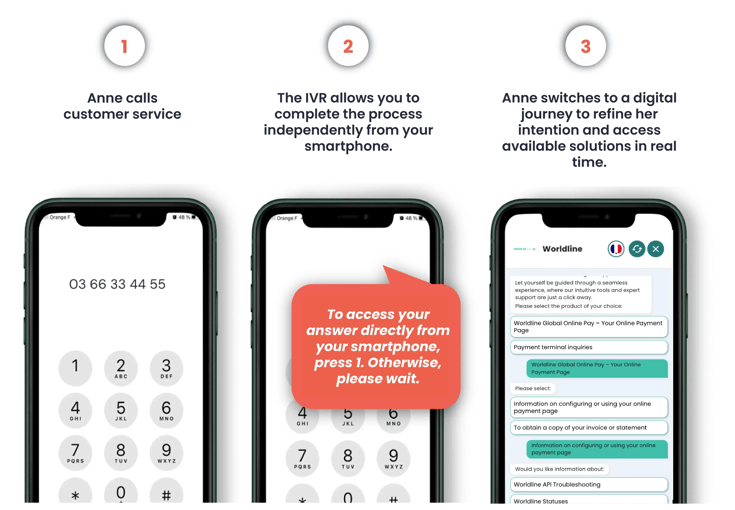
Visual IVR meets customer expectations for speed and simplicity while preserving the human connection through the phone channel.

What is a customer service advisor?

A customer service advisor is responsible for listening, understanding, and supporting clients in their daily requests, doing so with clarity, empathy, and responsiveness. Acting as the human link between a company and its customers, the advisor plays a central role in the quality of customer relations. They guide clients at every stage: answering questions, resolving technical issues, handling complaints, or directing them to the right solution. They have a solid grasp of the company’s products, services, and procedures. But their role goes beyond expertise, they must also listen attentively, explain clearly, provide reassurance when needed, and build trust. Often the first point of contact for clients, they embody the company’s image and values. 

In a context where customer expectations are rapidly shifting toward greater speed, clarity, and personalization, the advisor’s role must evolve as well. It is no longer enough to simply provide correct answers; responses must be fast, accurate, and delivered with genuine human connection. This requires adapting work practices, learning new tools, and strengthening both communication and digital skills.
 

The role of the customer service advisor before AI

Before the arrival of AI, the customer service advisor managed every stage of the client relationship manually. They welcomed customers, listened to their requests, navigated across multiple tools to find the right information, filled out forms, updated records, and wrote reports, all with attention, diligence, and availability. Advisors also had to show great adaptability when handling highly diverse requests: technical, administrative, or emotional. This approach, though demanding, fostered genuine proximity with customers and highlighted the advisor’s human skills. However, it relied heavily on operational organization, where repetitive tasks and time pressure often limited perspective and personalized support. Everything depended on the advisor’s responsiveness and endurance, sometimes at the expense of their work comfort or the quality of certain interactions. The role remained essential, but working conditions did not always allow advisors to fully leverage their relational strengths or build meaningful connections with each customer.

The arrival of artificial intelligence in customer service has transformed the daily work of advisors. AI goes beyond simply automating certain tasks, it reshapes the way they operate by taking over repetitive actions such as information searches, data entry, or updating records. The advisor is no longer just there to answer requests; they now lead the interaction, supported by tools that can quickly analyze large amounts of data, understand what the customer wants or feels, and suggest the right solution at the right time.

The real-time analysis of interactions, made possible by natural language processing (NLP), enables AI to capture not only the words spoken but also tone, intent, and emotion. This ability to read between the lines enhances the advisor’s support, helping them adjust their approach and response to each situation.

This shift has given rise to a new profile: the "augmented advisor" empowered by AI tools. Still at the heart of human interaction, the customer service advisor is now better equipped. With AI, they can prepare responses more easily, adapt their communication to each client, handle complex cases with greater composure, and even anticipate customer needs. They gain efficiency, responsiveness, and the ability to personalize every interaction.

The profession is therefore evolving into a more strategic role, that of a customer service expert who combines interpersonal skills, analytical thinking, and mastery of digital tools. AI does not replace this role; it expands it. By freeing up time, providing clarity, and supporting decision-making, AI allows advisors to focus on tasks with higher added value.


What are the benefits for advisors?

One of the first tangible benefits of AI for advisors is the time saved. By automating repetitive, time-consuming tasks such as automatically classifying requests or verifying customer data, advisors can handle more interactions without sacrificing quality and remain available even during peak activity periods. This time saving translates into a +20% increase in productivity, giving advisors more opportunities to focus on high-value tasks.

The quality of responses is also enhanced. With AI, often in the form of a conversational agent powered by the company’s knowledge base, advisors gain access to reliable, contextualized, and compliant content that meets both customer expectations and internal requirements. They simply ask the agent a question and instantly receive an answer complete with sources. This avoids approximations, reinforces message consistency, boosts credibility, and saves valuable time in accessing information.

AI also helps to better manage priorities. By analyzing the volume and type of requests in real time, it can flag urgent or sensitive situations and help organize case handling based on severity. This ensures a consistently high level of service, even under pressure. Such an approach has led to a 30% increase in employee satisfaction and a 25% boost in sales, thanks to better advisor recommendations.

Another major advantage lies in the reduction of mental workload. Fewer repetitive tasks, fewer last-minute decisions, less distraction. Advisors evolve in a smoother, more structured environment. They gain peace of mind, which benefits both their work comfort and the quality of customer relationships. This has enabled companies to reduce employee turnover by up to 30% through higher workplace satisfaction. Onboarding new hires is also simplified: the AI agent (new-generation AI chatbot) acts as a training assistant, helping them quickly grasp tools, procedures, and best practices. Modernizing the work environment in this way also strengthens the company’s appeal, especially among younger generations who are sensitive to technological innovation and workplace well-being.


  • Turnover

    -30% Reduced employee turnover thanks to greater job satisfaction

  • Sales

    +25% Increased sales through better advisor recommendations

  • Productivity

    +20% More time dedicated by advisors to high-value tasks

  • Satisfaction

    +30% Advisors satisfied or very satisfied


What AI tools support customer service advisors?

AI is no longer limited to chatbots, it has become a true support system for advisors, before, during, and after customer interactions. Here are the tools that are truly transforming their daily work:


Addressing customer needs or escalating

Le SVI visuel de DialOnce remplace les menus vocaux complexes par une interface visuelle déclenchée par SMS, qui oriente les clients vers le bon canal de résolution ou d’assistance.

Visual IVR

The Visual Interactive Voice Response (Visual IVR) system is an enhanced version of the traditional voice response system. It allows customers, when they call a customer service line or CRC (Customer Relations Center), and after receiving a text message containing a redirect link, to visually navigate from their phone through various options displayed as buttons, icons, or menus. This approach replaces long voice menus (“press 1, press 2…”) with a clearer and more intuitive interface.

Thanks to the visual IVR, customers can more quickly access the right service or channel (generative AI chatbot, form, callback...) based on their needs. It thus becomes a centralized and optimized entry point at the heart of an omnichannel orchestration strategy, where each request is routed to the most efficient path. For the company, this improves the distribution of requests, reduces misdirected calls, and increases customer satisfaction. For advisors, it saves a significant amount of time because they receive more qualified and contextualized requests directly, which makes it easier to resolve them and improves the quality of their interactions with customers.
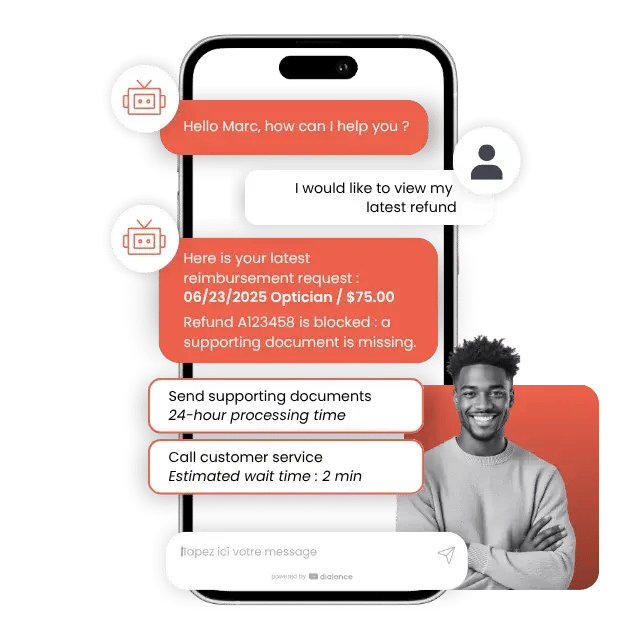
DialOnce AI agents automate customer service across all touchpoints combining sovereign infrastructure with deep CX expertise for seamless and trusted experiences.

AI agent and chatbot

The omnichannel AI agent or next-generation omnichannel AI chatbot, is an artificial intelligence tool capable of interacting with customers across all communication channels to help them resolve their issues. It handles simple, frequent, or urgent requests, such as helping customers track orders, schedule appointments, or update personal information.

It understands natural language (NLU), analyzes customer intent, and responds instantly with personalized responses, 24 hours a day and in multiple languages. This approach is part of a self-service model, also known as self-care, which allows customers to resolve their most common issues on their own, without needing to contact an advisor. When it cannot resolve an issue, it automatically forwards the request to the appropriate advisor, along with all the information already gathered during the initial interaction (original channel, reason for contact, customer history...). The advisor is thus better equipped to handle the request efficiently, with a clear understanding of the context from the moment they take over the case. This speeds up resolution and reduces the need for follow-up.

Freed from repetitive, simple, and time-consuming requests, advisors can focus on complex issues that require empathy, judgment, and expertise, ensuring optimal end-to-end service.


Tools to support advisors in real time and to optimize tracking and analysis

Augmented Advisor Agent

The Augmented Advisor Agent or virtual agent for advisors supports the representative in real time during interactions with customers. Integrated into the representative’s work interface, it analyzes conversations as they unfold and suggests ready-to-use responses tailored to the context.

It also searches the knowledge base for customer information (history, preferences, past complaints) and detects emotions or the level of urgency in messages using natural language processing (NLP). Using RAG (Retrieval-Augmented Generation) technology, this data is cross-referenced in real time with internal documents (FAQs, procedures, case histories) to provide contextualized and accurate responses. Its seamless integration with CCaaS platforms ( Genesys, Kiamo...) also ensures consistent responses across all channels. This enables advisors to respond more quickly without having to consult multiple documents more accurately and with greater empathy, while reducing the mental load associated with searching for information and formulating responses.


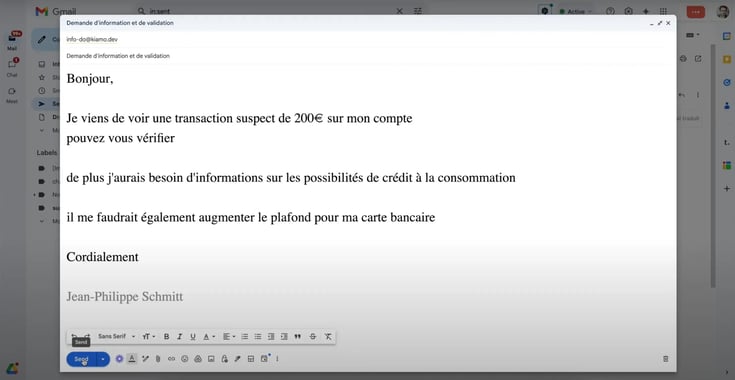
DialOnce's Mailbot automatically analyzes incoming emails, understands the customer's intent, and generates a personalized response in just a few seconds.

Mailbot

The mailbot is an intelligent assistant designed to automate the management of incoming emails. It analyzes each message received, identifies the customer’s intent, categorizes the email, and provides a tailored response in just a few seconds. Unlike older systems based on rigid templates or standard responses, the mailbot personalizes the content by taking into account the context of the request, the language, the history of interactions, and the customer’s profile.

This enables faster, more consistent, and uniform responses, while reducing the workload on customer service representatives. They no longer need to manually draft each response or search for scattered information: the mailbot centralizes, suggests, and accelerates the processing of requests.
Automated Post-Call Report: Time Savings and Reliability

Automated post-call summary

After each phone call, the artificial intelligence automatically transcribes the conversation and extracts the key points: the purpose of the call, topics discussed, decisions made, next steps, and more . This summary is clear, well-organized, and directly integrated into the client’s file.

This system eliminates the need for advisors to manually write their reports, saving them valuable time and reducing the likelihood of errors or omissions. It also ensures complete and consistent traceability of interactions, which is useful for monitoring and analyzing compliance and quality. For customer service representatives, this structured data also makes it easier to identify pain points, recurring needs, or opportunities to improve the customer journey.
Concrete use cases by sector

Banking

In the banking sector, AI is used to automate common requests such as tracking wire transfers, reissuing bank account information, or updating an address. For example, a visual IVR allows bank customers to easily select the reason for their call from their phone before even being connected to an advisor. This reduces misrouting and optimizes processing time. Once the request is identified, an omnichannel AI agent can automatically handle simple requests or forward more complex ones to an advisor, with all the relevant context already gathered.

If the call needs to be transferred to a call center advisor, the Augmented Advisor can then provide real-time support to the agent by displaying regulatory or pricing information relevant to the response. Once the interaction is complete, the post-call reporting tool summarizes the conversation and flags points requiring special attention, such as a compliance check. This combination of tools facilitates smooth, fast, and secure management of customer interactions.

Insurance

In the insurance sector, AI tools can, for example, automate responses to inquiries regarding the receipt and tracking of an insurance claim. When a policyholder reports an incident via email, an email bot can automatically analyze the content to extract key data (type of claim, date, location) and suggest an appropriate response, along with the required documents.

If the request requires further discussion, it can be forwarded to an advisor. Assisted by an augmented agent, the advisor can provide real-time guidance on best practices based on the nature of the policy or the policyholder’s specific terms. Smarter than a simple chatbot, the AI agent can also help the advisor anticipate potential objections or propose alternative solutions.

At the end of the call or interaction, the post-interaction reporting tool generates a structured summary, with alerts in cases of potential fraud or priority handling. All of these tools help reduce processing times, improve case traceability, and refocus the advisor’s role on providing personalized human support.

Social Housing

In the social housing sector, AI tools help better prioritize urgent requests and streamline the management of recurring inquiries. When a tenant reports a problem, an omnichannel AI agent can receive the request through the appropriate channel and, if it is a frequently asked question (e.g., a request for a receipt), respond automatically. For technical emergencies (e.g., heating failure, water leak), AI can trigger a priority alert and forward the request to the appropriate department along with all the collected information.

For administrative tasks (rent certificates, address changes), an email bot can provide an automated response template, which relieves advisors of repetitive correspondence and saves them valuable time.

During more complex interactions, an “augmented” advisor can suggest the appropriate procedures to follow based on the tenant’s profile, lease, or history. The automated report then makes it possible to track each interaction and share relevant information across departments (e.g., rental management, maintenance, social services).

All of these tools allow advisors to refocus on their core mission: supporting clients, anticipating high-risk situations, and maintaining close, trusted relationship with residents.


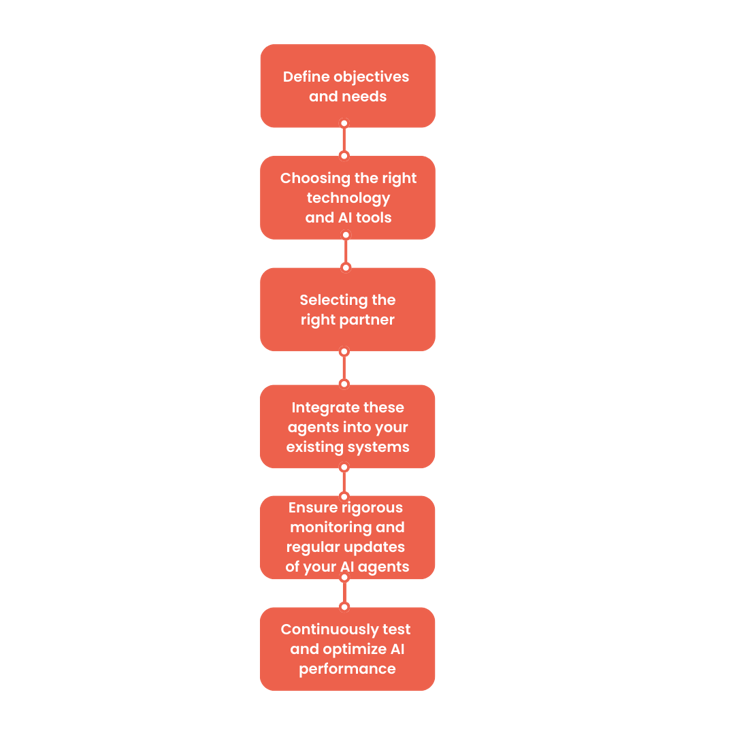
Key steps to deploy an AI agent with DialOnce

What are the best practices for integrating AI tools into customer service?

  • Clearly define the company’s objectives and needs: analyze existing processes to precisely identify tasks that are repetitive, time-consuming, or require a high level of analytical skill. This step helps pinpoint the areas to automate and maximize the impact of AI.

  • Select the most suitable AI technology and tools: evaluate the various available platforms and choose those that meet the identified needs while seamlessly integrating with the existing technology ecosystem (CRM, CCaaS, ERP, databases...). CCaaS solutions such as Kiamo and  Genesys, for example, allow you to centralize all customer engagement channels within a single interface, facilitate the integration of AI modules (virtual agents, sentiment analysis, automation), and provide a unified view of interactions.

  • Select an expert and experienced partner: choose a service provider with expertise in data science, fine-tuning AI models, and technical integration into business environments. This partner must know how to optimize the performance of AI agents (precise adjustment of prompts, use of advanced machine learning techniques) and possess solid business experience, particularly in customer relations. They must also support the company during the AI training phase, provide regular monitoring, and help build the skills of internal teams.


  • Ensure seamless and interoperable integration: make sure that AI integrates seamlessly with existing information systems and tools to avoid any disruption to processes and ensure optimal synergy.

  • Launch a targeted pilot project: start with a limited scope (department, channel, or type of request) to measure performance, analyze feedback, and make necessary adjustments before a full-scale rollout.

  • Continuously optimize through performance measurement: track key metrics (average handling time, satisfaction rate, advisors workload, response quality) and use this data to refine response accuracy, enrich the knowledge base, and improve the user experience.

  • Regularly update and modernize models: adapt AI agents to new trends, incorporate feedback, and leverage technological advancements to maintain a high level of performance and relevance.


What are the limitations of integrating AI tools into customer service?

While offering considerable benefits, integrating AI into customer relations requires a strategic and phased approach. This means ensuring the quality, diversity, and relevance of the data used especially when it involves sensitive information (personal, financial, or health data) while ensuring compliance with regulations such as the GDPR and the AI Act. It is essential to continuously improve AI scenarios so that they remain aligned with the company’s operational and strategic objectives, while incorporating feedback from the field and market developments. This approach ensures that responses remain relevant, tailored, and effective over time .

The hybridization combining human advisors and AI must be grounded in a philosophy of human support: AI does not replace the advisor; rather, it “augments” them by providing access to capabilities and information that would be impossible to obtain alone in real time. It acts as a strategic partner, capable of automating certain tasks, providing accurate and contextualized data, and facilitating decision-making. This hybrid approach combines the advisor’s relational and emotional expertise with the AI’s speed of analysis and virtually unlimited memory.

By leveraging solutions such as intelligent bots, omnichannel orchestration, self-service, and dynamic knowledge bases, the “augmented” advisor can focus on high-value interactions. Humans and machines work hand in hand, in an environment of process transparency, with clear traceability of decisions and seamless communication. This partnership, sustained by constant monitoring of technological developments and customer expectations, transforms every improvement into a driver of performance, satisfaction, and sustainable value creation.


To strengthen this trust, it is essential to develop verification and explainability models such as the “LLM as a Judge” approach that enable the reliability and relevance of generated responses to be verified. These practices fall within a framework of trustworthy AI, where every recommendation is validated and traceable. This synergy, sustained by constant monitoring of technological developments and customer expectations, transforms every improvement into a driver of performance, satisfaction, and sustainable value creation.


Far from replacing humans, artificial intelligence is profoundly transforming the role of the advisor. By taking over repetitive tasks, facilitating access to information, and providing real-time assistance, it allows advisors to refocus on what truly matters: the quality of the interaction, active listening, and resolving complex situations.

This change is not a break with the past, but an evolution. The advisor remains at the heart of the customer relationship, but is better equipped, more at ease, and more available. AI does not take the advisor’s place; rather, it empowers them to do their job better in a more fluid and demanding environment.

This new partnership between human intelligence and artificial intelligence paves the way for a clearer, more responsive, and more attentive customer relationship.


FAQ

  • DialOnce improves team performance by structuring requests before an advisor even gets involved. The platform qualifies customer intent, triggers the right workflows, and organizes interactions consistently across all channels. Teams no longer start from scratch: they handle requests that are already contextualized, with a clear understanding of the need and the key information required for resolution. This approach reduces internal friction, shortens handling times, and allows advisors to focus on high-value situations where their expertise truly makes a difference.

  • By qualifying and routing requests according to their level of complexity, AI agents prevent team overload and reduce interruptions. Simple requests are handled upstream through self-service, more complex cases are routed with the appropriate context, and time-consuming tasks are automated. Advisors work in a more stable environment, even during peak periods, while maintaining a consistent level of service quality. Customer interactions become smoother, without added pressure on teams, who can refocus on listening, empathy, and resolving high-value situations.

  • The DialOnce Augmented Advisor does more than suggest responses. It supports advisors in real time in their decision-making, based on the actual context of the interaction and on controlled, domain-specific content. Thanks to RAG (Retrieval-Augmented Generation), the information provided is directly linked to internal reference materials (procedures, knowledge sheets, etc.), ensuring accurate, consistent, and compliant responses. The advisor remains the final decision-maker and adapts to each situation. AI reduces the cognitive load associated with information retrieval and response formulation, while improving the consistency and overall quality of interactions.

  • Response quality is built into the core of the DialOnce platform. The AI agent relies on your knowledge bases containing your domain-specific content. Generated responses are based on validated, up-to-date sources and are continuously evaluated through supervision mechanisms and automated controls (LLM-as-a-Judge). This approach strengthens message consistency across channels, reduces approximations, and makes content updates easier to manage.

  • DialOnce's AI tools are designed to integrate seamlessly with your existing CRM systems, business tools, and CCaaS platforms (Kiamo, Genesys, Salesforce...). Teams keep their usual tools and ways of working, enhanced by an AI layer directly embedded into existing processes. Everything fits into a coherent orchestration of customer journeys. This integration simplifies adoption by teams and ensures operational continuity, with no disruption to established workflows.