
Deliver a seamless customer journey through omnichannel orchestration
Omnichannel orchestration is now a central component of effective customer relationship strategies. Faced with increasingly fragmented customer journeys across physical, telephone, and digital touchpoints, companies must ensure continuity, fluidity, and consistency in every interaction. This guide provides you with the keys to understanding the challenges and effectively structuring and optimizing your omnichannel approach.
What is omnichannel orchestration?
Omnichannel orchestration is a company’s ability to connect and synchronize all of its communication channels in real time: website, mobile app, email, phone, social media, brick-and-mortar stores... Unlike a multichannel approach, where each channel operates in isolation, omnichannel aims to interconnect them to provide a seamless experience throughout the customer journey.
This allows customers to start an interaction on one channel and continue it on another without having to repeat their information: the context is carried over. For example, if a customer asks a question via a chatbot on the website, the orchestrator detects an urgent contact reason and transfers the inquiry to an agent, who calls the customer back already familiar with the history of the interaction. This personalized support relies on real-time data synchronization between different systems (CRM, contact center, engagement platforms...) and close collaboration between the marketing, customer service, and sales teams.
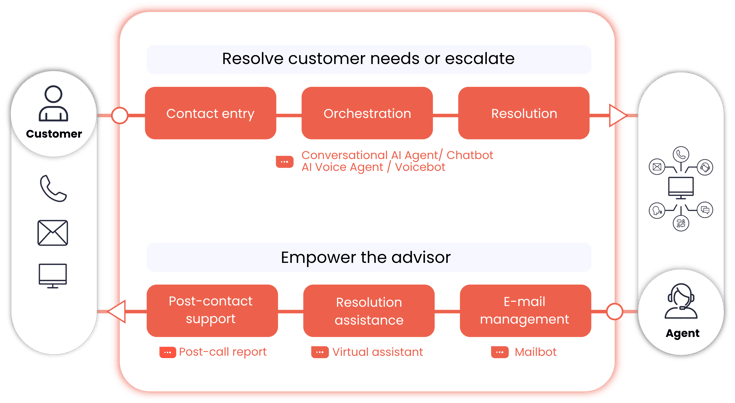
This orchestration often takes the form of an AI-powered chatbot capable of detecting the intent behind each customer inquiry. Depending on the nature of the request and the routing rules defined by the company (agent availability, business hours, priority level...), the agent (a next-generation AI chatbot) can either provide an automated response or transfer the conversation to a human agent (via phone or live chat), while retaining the context history to ensure a seamless customer experience.
Multichannel, cross-channel, or omnichannel: what are the differences?
These three approaches are often confused, but they correspond to very different levels of integration:
Multichannel involves using multiple communication channels (website, social media, phone, stores, print catalogs...), but independently. Each channel is managed separately and does not share information. Customers often have to repeat their information when switching channels, which fragments the customer journey and can lead to frustration.
Cross-channel goes a step further by linking the channels together to streamline the customer journey. For example, a customer starts a purchase online, chooses in-store pickup, and then contacts customer service by phone. Information flows between channels, ensuring continuity. This approach often relies on tools such as CRMs, contact centers, or order management systems.
Omnichannel takes this logic to the extreme: all channels are synchronized in real time and share a single customer history. The customer can switch from one channel to another without ever losing track of their interaction. For example, a customer starts by making a phone call to report a problem. They are directed to an interactive voice response (IVR) system that collects initial information and identifies the reason for the call. Depending on the complexity of the request, the interaction is then transferred to a conversational AI agent, and if necessary, to a live chat with a human agent, who immediately has access to the entire history collected by the IVR and the conversational AI agent. This synchronization relies on interconnected systems and close collaboration between teams to ensure a seamless, personalized, and consistent experience.
Learn more about these differences in our article: What Are the Differences Between Multichannel, Cross-Channel, and Omnichannel?
Why implement an omnichannel strategy?
A well-designed omnichannel strategy creates value on several levels:
-
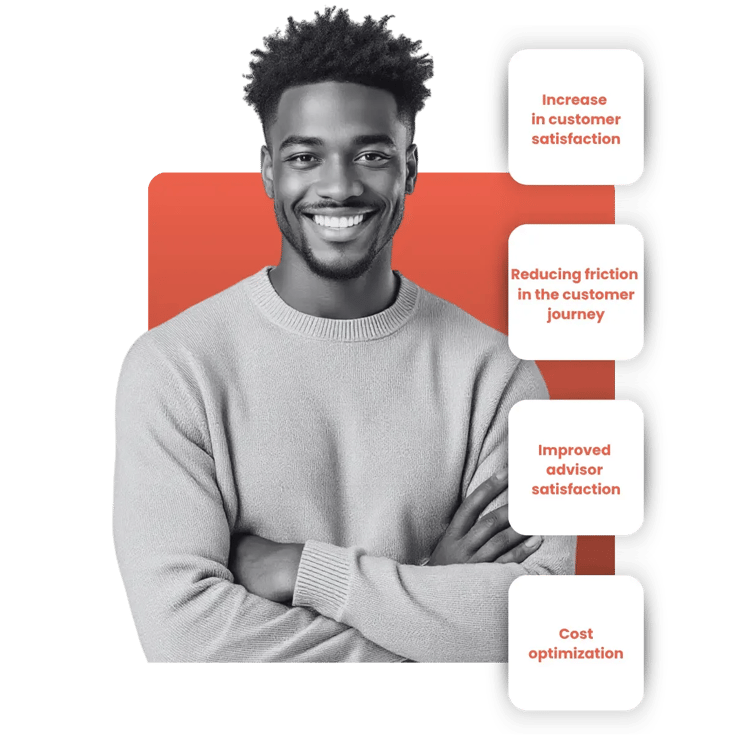
It improves customer satisfaction by offering seamless, fast, and personalized interactions, which fosters a lasting relationship of trust
-
It reduces friction in the customer journey by eliminating the need to repeat information and ensuring seamless continuity across channels
-
It improves agent satisfaction: agents benefit from a richer context and optimal conditions to respond effectively, thanks to the information provided by the chatbot and the centralization of interactions.
-
It optimizes costs by simplifying internal processes: requests are better routed, tools are utilized more effectively, and teams can focus on high-value interactions
-
It enriches customer knowledge by centralizing all interactions within a single system, providing a comprehensive view of the customer journey and enabling the anticipation of needs
71% of customers expect companies to collaborate internally to avoid having to repeat themselves. To achieve this level of fluidity, implementing an omnichannel strategy requires a phased approach. It all starts with a detailed analysis of existing touchpoints to identify the strengths and weaknesses of the current customer experience. Next, customer data must be centralized in a single repository (often a CRM) accessible to all relevant teams: marketing, sales, and customer service.
It is also essential to rely on reliable technological tools such as CRMs, omnichannel orchestration platforms (DialOnce), or marketing automation solutions capable of synchronizing information in real time, while ensuring data security and confidentiality. Beyond the technical aspects, omnichannel strategy also relies on internal transformation: fostering a customer-centric culture, breaking down silos between departments, and placing continuous improvement at the heart of the approach.
Discover how Vattenfall deployed an omnichannel orchestration platform to manage all of its customer journeys. By directing each contact toward the most appropriate resolution path (website, phone, email), the platform centralizes customer intent and promotes resolution on the first contact, while simplifying the customer experience.
> Read the case study
What are the foundations of successful omnichannel orchestration?
To be effective, an omnichannel strategy rests on five inseparable pillars that combine technology and organization:
-
A single customer database: a centralized database that consolidates all customer information. This allows every department (sales, support, marketing...) to access a clear and up-to-date view of the customer, regardless of the channel used.
-
Seamless channel integration: all channels must be interconnected to ensure continuity of communication. For example, a conversation started via chat should be able to be continued over the phone or in-store without any loss of information.
-
Intelligent routing rules: these rules automatically direct customer requests to the right department or channel based on criteria such as history, urgency, or team availability.
-
A centralized orchestration platform: acting as a true control center, it coordinates all channels and automates certain interactions, ensuring consistency in customer journeys and messaging throughout the customer lifecycle.
-
Teams aligned with customer goals: people remain at the heart of omnichannel strategy. All employees must be trained, informed, and engaged to deliver a consistent experience, regardless of their role or the channel through which they interact with customers.
How to implement an omnichannel customer relationship strategy?
Implementing an omnichannel customer experience cannot be done on the fly. It relies on a series of structured steps that ensure a smooth, consistent, and effective transition to this new approach:
-
Map out current customer journeys: start by identifying all the touchpoints your customers use. The goal is to pinpoint points of friction, underutilized channels, and redundancies. Also analyze the reasons for contact to better understand expectations based on customer profiles.
-
Design a customer-centric strategy: it’s not just about adding channels, but about understanding needs, recurring pain points, and key stages of the customer journey. This analysis allows you to target optimizations that will have a direct impact on efficiency and customer satisfaction.
-
Centralize data: it is essential to connect all channels to a unified database (CRM or CDP) to enable a comprehensive, real-time view of the customer. This centralization facilitates the intelligent routing of requests to the most appropriate channels.
-
Selecting the right tools: orchestration platforms , AI solutions, and automation systems must be able to integrate with your existing tools and adapt to your operational workflows. They must also facilitate the sorting, prioritization, and rerouting of requests, particularly during peak periods.
-
Align and train teams: marketing, customer service, IT… all stakeholders must be involved from the start. Targeted training facilitates the adoption of new tools and practices, while fostering a culture centered on responsiveness and personalized service.
-
Monitor and adjust: once the system is in place, it’s essential to track key metrics (transfer rates, response times, first-contact resolution rates...) and regularly adjust your processes to ensure continuous improvement in the customer experience. The goal is to make each channel not only accessible but also relevant at the right time and for the right inquiry.
Omnichannel orchestration and artificial intelligence
Artificial intelligence (AI) now plays a strategic role in optimizing omnichannel orchestration. In particular, it enables:
-
Pre-qualification and intent detection: by analyzing behavioral and contextual data, AI understands customer intent (request for a quote, complaint, cancellation...) and instantly suggests the most relevant customer journey. This reduces unnecessary transfers and maximizes first-contact resolution by providing immediate responses to simple requests and efficiently routing more complex requests to the right representatives.
-
Immediate responses to simple inquiries: AI agents and AI chatbots handle a high volume of recurring inquiries 24/7. When an inquiry is too complex to be answered directly, the AI orchestrates its transfer to a human agent, who takes over with all the information already centralized.
-
Dynamic channel orchestration: AI determines the optimal channel in real time based on the customer’s habits and the nature of the inquiry. For example, thanks to the visual IVR, an incoming call can be instantly routed to a digital self-service solution (self-resolution, such as directing the customer to an online FAQ) if that solution can resolve the inquiry without human intervention. This dynamic redirection approach reduces the workload on agents and optimizes customer engagement.
-
Harmonizing human and automated interactions: by centralizing interaction history, AI ensures seamless continuity across different levels of service. When a human agent takes over, they benefit from an Augmented advisor natively integrated into your internal tools via API, which automatically provides context for the request, generates summaries of previous exchanges, and suggests the next best action... . This assistance enables the agent to handle complex requests more efficiently, accurately, and quickly.
These capabilities not only make it possible to better meet customer expectations, but also to lighten the workload on human teams and reduce operating costs. AI thus becomes a true co-pilot in customer relations.
To take full advantage of these opportunities, a genuine organizational transformation is necessary. AI enhances the work of human teams by relieving them of simple, repetitive tasks, while allowing them to focus on more complex and strategic requests. We must therefore rethink processing workflows, automate the most routine tasks, and ensure a seamless transition between automation and human intervention to provide customers with a consistent, fast, and situation-specific experience.
This transformation must be approached with the teams’ operational realities in mind: Which tasks can be handled by AI? Which interactions must remain human? How can we ensure a seamless flow of information between the two? Well-designed orchestration strikes a balance between responsiveness, efficiency, and personalization, while preserving the essential role of employees in high-value-added interactions.
To learn more, download our white paper on Customer Excellence and Omnichannel Orchestration: 2025 Edition, co-authored with BearingPoint.
Examples of omnichannel orchestration by industry sector
Banking & Insurance
Banks and insurance companies are facing growing and increasingly diverse volumes of customer interactions: requests for advice, complaints, urgent matters related to contract management or incidents… These interactions come through various channels (phone, branches, email, mobile apps) and require a swift and consistent response. Omnichannel orchestration enables standardized access to customer information, streamlines transfers between channels, and better allocates advisors to handle complex requests. Here are two concrete use cases:
-
BNP Paribas Epargne & Retraite Entreprises has redesigned all of its contact channels to handle peaks in activity, directing customers to the right pathways from their very first contact while ensuring service quality.
-
Crédit Agricole Normandie-Seine has optimized its digital customer experience by implementing an automated request routing system that facilitates access to the right resources and reduces wait times.
Energy
In the energy sector, providers often face spikes in customer inquiries related to billing cycles, contract activations, or requests to change service plans. Omnichannel orchestration streamlines the distribution of requests by offering tailored digital solutions for simple inquiries and engaging agents only when human expertise is required.
-
Vattenfall reduced its operating costs by 35% by deploying a visual IVR that directs incoming calls to the most appropriate digital solutions.
-
ENGIE has improved its reachability by prioritizing automated digital channels and optimizing the management of incoming traffic.
Distribution / Retail
In the retail sector, the challenge is to provide a seamless customer experience across the e-commerce site, physical stores, and customer service. Omnichannel orchestration centralizes customer history, automates recurring requests, and allows human intervention when necessary.
-
Fnac Darty has implemented an omnichannel reachability strategy that combines automation with human support, thereby reducing costs while improving customer satisfaction.
What KPIs should be tracked to measure the performance of your omnichannel strategy?
Tracking the right metrics is essential for evaluating the performance of an omnichannel strategy. It’s not just about collecting data, but about drawing concrete insights from it to continuously improve the customer experience.
-
NPS (Net Promoter Score) and CSAT (Customer Satisfaction Score): these metrics measure perceived satisfaction and customers’ likelihood of recommending the brand. They help quickly identify pain points throughout the entire customer journey.
-
First-Contact Resolution (FCR) Rate: this metric measures the ability to resolve an inquiry during the first interaction, without the need for follow-up or switching channels. In an omnichannel environment, this metric is crucial for evaluating the effectiveness of AI agents, next-generation AI chatbots, visual IVRs, and automated systems.
-
Cross-channel transfer rate: this indicates the percentage of requests that must be escalated to another channel (for example, from an AI agent to the phone). A high rate may indicate poor initial targeting or a lack of autonomy in digital channels.
-
Digital channel abandonment rate: this rate measures the number of users who leave a digital channel (chatbot, form...) before receiving a response. A low abandonment rate indicates a clear interface, well-designed user flows, and quick responses.
-
Average handling time: this metric helps assess team efficiency and the smoothness of request handling, while identifying potential bottlenecks.
-
Digital channel usage rate: this metric provides insight into customers’ adoption of digital solutions and the company’s ability to reduce pressure on human-staffed channels.
Cross-analyzing these metrics, tailored to customer profiles and different reasons for contact, serves as a powerful driver of continuous improvement. The goal is to simplify customer journeys, minimize friction, and optimize resource allocation to deliver a seamless and effective customer experience.
Omnichannel orchestration is now essential for companies that want to offer a simple, seamless, and effective customer experience. By connecting channels, leveraging data and artificial intelligence, and aligning teams around common goals, companies improve their ability to understand customer expectations, respond quickly, and provide tailored solutions. Omnichannel thus becomes a true driver of sustainable performance and a key differentiator in the face of increasingly demanding customers.