Everything you need to know about customer service in the age of artificial intelligence
Losing a customer is a warning sign, often indicative of a customer relationship that deserved more attention. The customer experience has become a key differentiator, just like the products or services themselves. Customer satisfaction, once viewed as a mere operational metric, has now become a strategic priority, regularly analyzed at the highest levels of organizations, including by executive committees. It reflects perceived quality, service effectiveness, and customer brand loyalty. Yet many consumers still feel they are treated as mere numbers. To reverse this trend, it has become essential to personalize every interaction, streamline customer journeys, and strengthen customer listening. It is in this context that artificial intelligence (AI) has emerged as a major asset: by making services more responsive, more predictive, and more human, it is profoundly transforming customer relationship management.
Check out our guide to AI in customer service and explore how this technology can improve the experience for your business, your customers, and your teams.
What is customer relationship management?
Customer relationship includes all the practices, strategies, and technologies that companies use to manage and improve interactions with current and potential customers. It follows a customer-centric approach, aiming to better understand customer needs, anticipate expectations, and provide a smooth, consistent, and engaging experience. In contrast, customer service focuses on specific situations responding to a request or solving a particular problem.
Customer relationships encompass all the emotions and perceptions a customer experiences throughout their interaction with the company before, during, and after the purchase and depend just as much on the quality of the products or services as on the quality of interactions with the company’s teams. Every interaction, no matter how small, can strengthen or weaken the brand’s image. According to the BDM, 88% of consumers say that the experience matters just as much as the product. That is why managing the customer experience must be viewed as an ongoing process, fully integrated into the company’s overall strategy. The goal is to build a lasting relationship of trust through personalized and relevant interactions. This requires clear communication, effective responsiveness, and solutions tailored to each situation. All employees must be aligned around common goals to ensure consistency in the customer’s experience.
In the digital age, technological tools play a key role in this process. CRM platforms, AI-powered customer service chatbots, and predictive analytics enable companies to automate certain tasks, better target customer needs, and deliver a faster, more personalized, and more human experience.
By integrating these AI technologies into their customer relationship strategies, companies can improve customer satisfaction and loyalty while strengthening their competitiveness through an innovative and distinctive experience.
The challenges of customer relationship management
In a context where consumer expectations are rapidly evolving, the quality of customer relationships has become a key driver of performance. Here are the three main challenges of customer management:
Customer satisfaction: effectively meeting customer expectations to satisfy them and build loyalty. A satisfaction-centered approach involves active listening, tailored responses, and anticipating needs. Yet customer relations are often relegated to the background, perceived as time-consuming and offering little added value. However, when integrated across all teams, it becomes a powerful driver of growth. A seamless and positive experience drives lead generation and strengthens customer loyalty through tailored responses delivered via the right channels. As a result, a satisfied customer is more likely to recommend a brand and remain loyal to it over the long term.
Customer Loyalty: strong customer interactions encourage customers to return, thereby reducing the cost of acquiring new customers. Today, consumer behavior is evolving, and companies must adapt by diversifying their communication channels: physical retail locations, emails, phone calls, chatbots, social media, and customer reviews. The ability to interact effectively across these various channels strengthens brand loyalty. Well-designed loyalty programs, efficient after-sales service, and personalized interactions also reinforce this commitment.
Competitive advantage: excellent customer support can set a company apart from its competitors. While some companies still overlook this lever, others incorporate it as a key strategic element. By implementing a detailed analysis of customer interactions and adapting their actions based on feedback, companies can optimize their market positioning and strengthen their competitiveness. Providing a high-quality customer experience thus allows them to stand out in the long term and build a strong bond of trust with consumers. A company that prioritizes customer satisfaction enjoys a better reputation and positive word-of-mouth, both of which are essential for its growth and long-term sustainability.
According to an Odoxa study for Kiamo (“The French and Customer Service in the Age of Artificial Intelligence - 2023”), only 56% of French people say they feel valued when they contact customer service, and 62% express dissatisfaction with wait times. This underscores the importance of rethinking how customer service is organized so that it is more responsive, accessible, and attentive to customer expectations.
The key components of a successful customer relationship
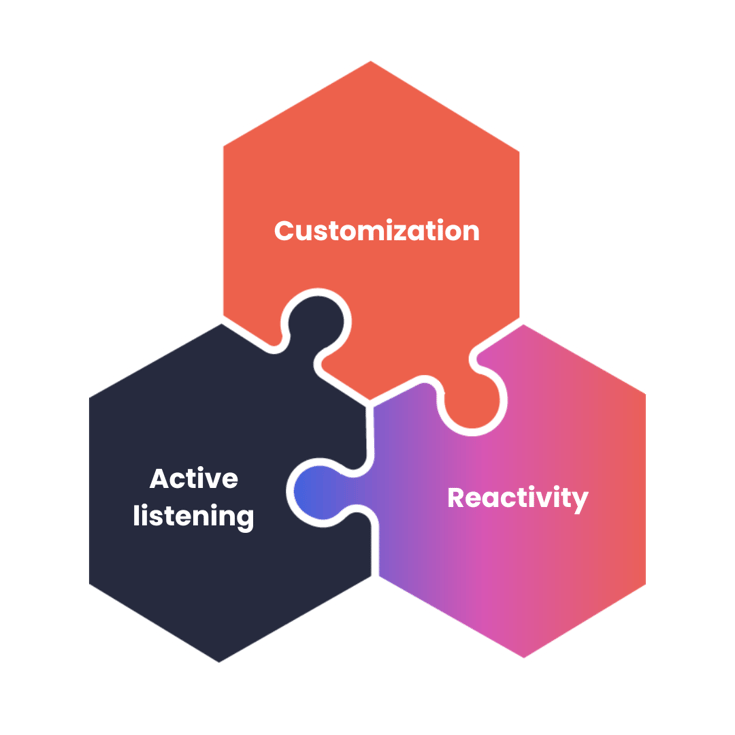
In an environment where every interaction counts, building strong customer relationships has become an essential strategic asset. Here are the key areas to optimize:
Active listening
Understanding customers’ needs and expectations is essential for building a strong relationship. This involves not only listening attentively but also establishing appropriate communication channels that allow customers to express themselves freely. Active listening goes beyond simply receiving requests: it requires the ability to detect subtle cues such as hesitations, unspoken concerns, or frustrations.
Satisfaction surveys, analysis of customer reviews, and social media interactions provide key insights for identifying consumers’ underlying expectations. When integrated into a comprehensive strategy, this data enables companies to tailor their offerings, optimize services, and enhance the relevance of customer interactions.
This reassures customers and reinforces their sense of being understood. The use of tools such as online questionnaires, discussion sessions, or automated analysis of emotions and sentiments helps structure this dialogue in a continuous and constructive manner, while anticipating future needs.
Personalization
Tailoring services and communications to each customer’s preferences and behavior reinforces their sense of being valued and important. Today, consumers expect tailored interactions, and successful companies are those that manage to deliver highly personalized experiences.
Thanks to customer data and customer relationship management (CRM) tools, it’s possible to send precise recommendations, tailor shopping journeys, and provide more personalized responses. A proactive approach such as sending reminders, birthday emails with special offers, or promotions tailored to the customer’s needs strengthens brand loyalty. Furthermore, incorporating personalized content into communications such as explanatory videos, user guides, and tailored advice, not only strengthens brand loyalty but also enhances the user experience.
Responsiveness
Customers appreciate quick and relevant responses to their inquiries. In a world where immediacy has become the norm, a company’s responsiveness strongly influences brand perception and customer loyalty.
Implementing multiple channels such as customer service chatbots, interactive FAQs, phone support, and social media, enables companies to respond quickly to inquiries and provide continuous support. In addition, some companies adopt expectation management strategies by informing their customers about average response times and offering them alternative solutions while they wait.
Automating certain tasks with AI agents (next-generation AI chatbots) helps streamline the handling of repetitive requests, thereby freeing up time for human agents. However, it is essential that these solutions remain accessible and transparent to avoid customer frustration. The combination of automated assistance and optimized human intervention helps strike a balance between efficiency and satisfaction.
Finally, responsiveness also involves anticipation: analyzing customer behavior and recurring questions helps optimize internal processes and offer solutions even before the customer makes a request. By anticipating needs and providing effective self-service tools, a company can improve the customer experience and reduce the workload of its customer service department.
Artificial intelligence at the heart of customer relationship transformation
Artificial intelligence (AI) refers to all technologies capable of simulating human cognitive functions, such as natural language understanding, learning, and problem-solving. Thanks to recent advances in data processing, AI has become established in many sectors, and customer relations are no exception.
The emergence of generative AI marks a new stage in the evolution of customer relations, enabling more natural interactions in everyday language and paving the way for a growing variety of use cases, ranging from automated support to the proactive creation of personalized content. The integration of AI into the customer experience initially took the form of automating certain simple tasks, such as sorting requests or answering frequently asked questions. But very quickly, it enabled companies to go far beyond that: personalized interactions, anticipating customer needs, and improved response times have become expected standards.
By enabling companies to better understand customer behavior and optimize their resources, AI does more than simply streamline customer satisfaction, it reinvents it. Thanks to its ability to perform large-scale analysis and continuously adapt interactions, it has become a strategic asset for creating more relevant, seamless, and engaging experiences.
At the same time, new systems now enable certain LLMs to evaluate other AI systems, based on the “LLM as a judge” principle. This evaluation capability paves the way for trustworthy AI, where automated decisions can be supervised, corrected, and guided, thereby strengthening the reliability and ethics of customer-company interactions.
According to HubSpot, 72% of salespeople who use AI say it helps them build trust with their customers more quickly.
New tools supporting customer relationships
Chatbots and AI agents: these intelligent conversational interfaces automate first-line customer interactions. Capable of handling a large volume of simultaneous requests, they provide instant, consistent, and context-aware responses. Thanks to machine learning and natural language processing (NLP) algorithms, they continuously improve based on past interactions, refine their understanding of user intent, and offer increasingly nuanced personalization.
Visual IVR: an evolution of the traditional Interactive Voice Response (IVR) system, visual IVR enhances the user experience by displaying guided workflows directly on a smartphone or browser. This significantly reduces cognitive load and navigation errors, while streamlining access to services. This type of tool fits perfectly into an effective self-service model, allowing customers to resolve their issues without human assistance, while still retaining the option to escalate to an agent.
CRM (Customer Relationship Management): such as Salesforce, are becoming intelligent hubs for customer data. By centralizing interaction histories, preferences, and purchasing behaviors, they enable advanced behavioral segmentation and omnichannel orchestration of customer service. Integrated with AI modules, these systems can also provide predictive churn scores, recommendations, or proactive alerts to call center agents.
Omnichannel engagement platforms: these platforms enable real-time management of all customer interactions across all channels (email, phone, chat, social media, instant messaging) from a unified interface. This ensures a seamless, consistent, and uninterrupted experience, with full traceability of every interaction. When paired with AI tools, these platforms can prioritize requests, analyze emotions expressed in messages, or route conversations to the most appropriate customer service agent.
Automation and proactive communication tools (mailbots, sequencing tools, smart notifications): these technologies enable the automatic sending of targeted messages based on customer behavior, the stage of the customer journey, or trigger events (upcoming renewal, inactivity, policy changes...). They help maintain regular contact with customers, anticipate their needs, and trigger personalized actions at the right time, without human intervention. When paired with scoring or CRM tools, these email bots can orchestrate large-scale customer engagement campaigns while maintaining a personalized touch.
Intelligent voice assistants (voicebots): these automated systems handle voice requests via incoming calls or voice interfaces. Using natural language processing (NLP) and speech recognition, voicebots can answer simple queries, guide users through a dynamic voice menu, or transfer them to the appropriate representative. They offer a modern alternative to traditional IVR systems, reduce wait times, improve customer service accessibility, and provide a more seamless experience across channels that are still widely used, particularly over the phone.
Feedback and sentiment analysis tools: by combining post-call surveys, customer reviews, and semantic analysis, these solutions enable large-scale customer listening. Automated processing of verbatim comments using AI helps identify recurring pain points, measure satisfaction in real time (NPS, CSAT, CES), and continuously adjust processes. Some tools even go so far as to propose automatic action plans based on customer feedback identified as critical.

The main benefits of using AI in customer relationship management
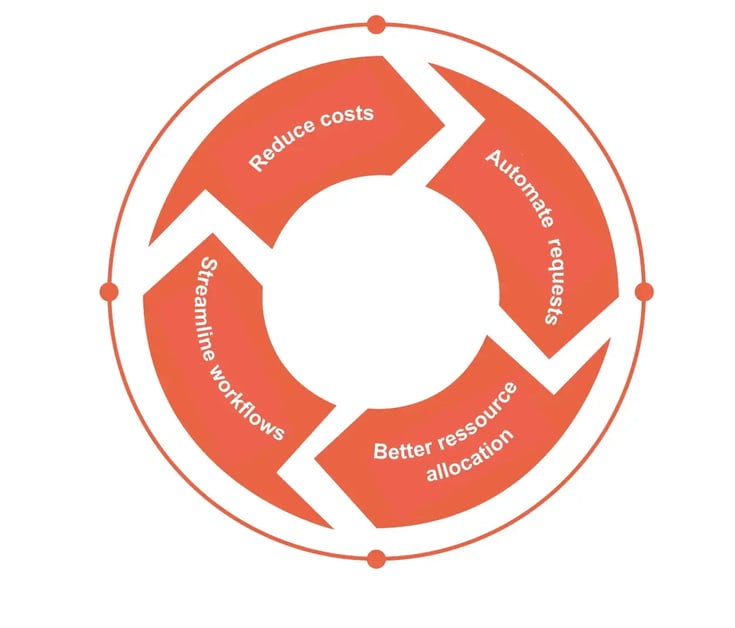
First and foremost, AI helps reduce operational costs by automating routine requests, which frees up call center agents to focus on complex, high-value-added tasks. This automation enables better resource allocation, a more agile organization, and the streamlining of internal workflows.
It also improves operational efficiency by handling repetitive and time-consuming tasks, thereby reducing processing times and human errors. This boosts the productivity of customer service representatives, who can then focus on more rewarding tasks, thereby increasing their engagement. This efficiency is particularly evident in an omnichannel approach, where AI enables the centralization and synchronization of interactions across all channels (phone, email, chat, social media). Customers thus benefit from a seamless journey with no gaps between touchpoints, which enhances the consistency and quality of the experience.
To learn more, download our white paper, Customer Excellence and Omnichannel Orchestration: a Strategic Guide to Transforming Your Customer Relationships Through Integrated, Seamless, and High-Performance Customer Journeys.”
By facilitating this continuity of service, AI also makes it possible to manage a high volume of simultaneous requests across all channels, ensuring seamless and consistent support regardless of the contact method used. This ability to maintain a consistent level of quality directly contributes to increased customer satisfaction, particularly through instant responses available 24/7, which significantly reduce wait times and improve the overall perception of the service.
At the same time, AI enables highly personalized interactions by leveraging customer data to tailor offers, recommendations, and messages to each individual’s profile. It also helps anticipate needs through predictive analytics, making interactions more relevant and proactive.
Finally, certain AI systems can assist customer service representatives in real time by providing them with contextual information and suggestions for action, which improves the first-contact resolution rate. In this context, the agent is said to be “augmented” by artificial intelligence tools. Furthermore, thanks to machine learning, AI continuously improves its performance and responses as interactions occur.
These numerous benefits make AI a major strategic lever for building a more effective, personalized, and responsive customer relationship focused on long-term customer satisfaction.
Examples of how artificial intelligence is used in customer relationship management
Digitizing calls during a crisis
During times of high stress or crisis, maintaining customer service continuity becomes a strategic priority. Many organizations turn to digital solutions, particularly visual IVR, to relieve pressure on call centers and efficiently route inquiries. This type of automated interface allows users to quickly access answers without direct human intervention, while still retaining the option to escalate to an agent.
In the public and healthcare sectors, the implementation of online appointment scheduling interfaces, telemedicine, and interactive forms has improved access to essential services. These systems promote greater user autonomy and improved responsiveness to high volumes of inquiries.
Example: The Ministry of Solidarity and Health used DialOnce’s visual IVR solution to route calls to the appropriate information channels during the COVID-19 crisis, resulting in maximum reachability, with 100% of calls being handled.
Enhanced customer service in social housing
The social housing sector is also transforming its relationship with users through AI. To handle a growing volume of inquiries while maintaining high-quality human support, social housing providers are now integrating conversational AI agent solutions (next-generation AI chatbots) capable of handling simple and recurring tenant requests.
This is the case with 1001 Vies Habitat, which has implemented a conversational AI agent to streamline communication with its tenants. This system provides instant responses 24 hours a day on topics such as administrative procedures, service requests, or contact information. The result: a significant improvement in service availability and a more efficient distribution of inquiries to dedicated teams.
Improving the customer experience in the banking and insurance sectors
The banking and insurance sectors are turning to digital solutions to enhance the quality of customer support, amid growing expectations for responsiveness, simplicity, and security. These institutions are increasingly integrating AI agents, virtual assistants, and intelligent automation tools to efficiently handle simple requests and direct customers to the right representatives when human assistance is needed.
In the banking sector, the benefits are already evident. For example, Crédit Agricole Nord-de-France has implemented a visual IVR system with DialOnce to optimize the management of its incoming calls. The results: a 25% reduction in redundant calls, a gain of 3,500 hours in productivity, and a significant improvement in reachability, without compromising the quality of the customer experience.
In the insurance sector, digital solutions have helped clarify and streamline the customer journey from the very first point of contact. Automating the initial greeting and routing of inquiries reduces wait times and limits the workload on agents. This is the case at GMF, which deployed a visual IVR to simplify the initial interaction. As a result, 84% of users report being satisfied with the new customer journey, with a 20% decrease in calls transferred to agents.
Personalization and support in the travel industry
In the tourism industry, the ability to provide responsive, multilingual, and personalized customer service is a key differentiator. Industry players rely on automated interfaces to support customers from the booking phase through to post-trip feedback.
Thanks to AI agents, behavioral analytics, and real-time notifications, industry professionals can anticipate needs, reassure customers in the event of unforeseen circumstances (delays, flight changes), and enhance the overall experience with content and services tailored to the traveler’s profile.
Example: The Lastminute.com website uses an automated assistance solution to handle requests to modify or cancel reservations, significantly reducing the workload on its support services.
The challenges of customer relationship management in the age of AI
Integrating artificial intelligence into customer relationship management systems presents a great opportunity to rethink customer journeys and increase agility. Far from being a hindrance, this technological evolution enables companies to intelligently connect their tools (CRM, contact centers, IVR, omnichannel platforms...) to create a unified view of the customer. Close collaboration between IT and customer management teams, supported by targeted testing and training phases, ensures a smooth adoption process and a gradual increase in employee proficiency.
Another key consideration is striking the right balance between automation and human intervention. While AI can help relieve pressure on contact centers, it cannot respond to every request with the same level of empathy or judgment as a customer service representative. Maintaining a human touch, especially for complex cases, is essential to preserving the quality of the relationship and customer satisfaction.
In an increasingly demanding digital environment, data security is a central concern for all companies. The management of sensitive data, particularly personal data, remains a top priority: any breach in its processing or storage can undermine user trust and damage the organization’s reputation. To meet these requirements, it is essential to implement robust encryption, strong authentication, and access control measures, while complying with applicable regulatory frameworks such as the GDPR or HIPAA in the most sensitive sectors. The integration of digital solutions, including those using AI, must be accompanied by strong safeguards regarding data protection and governance.
Finally, instances of “hallucinations” (the generation of erroneous or incoherent content) serve as a reminder that generative AI is not infallible. To limit these issues, several complementary measures are essential: maintaining active human oversight, training models on reliable data, and regularly monitoring their performance over time.
There is already a particularly promising approach known as “LLM as a judge.” The idea is simple: use one AI to evaluate the work of another AI, specifically by verifying the quality and consistency of the generated responses. This introduces a form of automated regulation and enhances the reliability of AI applications. This is a promising step toward AI that is more regulated, more transparent, and therefore more trustworthy.
How can the effectiveness of artificial intelligence in customer relationship management be measured?
The integration of artificial intelligence into customer relations aims to improve the user experience, streamline interactions, and increase operational efficiency. To effectively assess the impact of these technologies, it is essential to track appropriate key performance indicators (KPIs). Here are the main KPIs for measuring the effectiveness of AI:
-
Net Promoter Score (NPS): measures the likelihood that a customer will recommend a brand to others. An improvement in the NPS following the introduction of AI solutions (agents, chatbots, visual IVR, smart recommendations) may indicate increased satisfaction and a more positive perception of the overall experience.
-
Customer Satisfaction Score (CSAT): assesses immediate satisfaction following an automated interaction. Comparing the CSAT before and after implementing an AI agent allows you to evaluate the relevance of the generated responses and the perceived quality of service.
-
Customer Effort Score (CES): indicates the level of effort required by the customer to obtain a response. An effective AI system should reduce this score by providing instant, context-aware responses without complex navigation or multiple transfers.
-
First Contact Resolution (FCR): measures an automated system’s ability to resolve an issue during the first interaction. Well-trained AI can help significantly improve this rate, particularly through AI agents or predictive voice assistants.
-
Average Handling Time (AHT): a key objective of AI is to reduce the time required to handle a request. Automating simple responses or providing human agents with enriched context helps lower AHT while maintaining or even improving service quality.
-
Human Channel Offload Rate: AI is effective when it relieves contact centers of repetitive inquiries. This metric measures the percentage of requests handled automatically without human intervention, freeing up time for complex inquiries.
-
Analysis of Post-AI Interaction Customer Feedback: qualitative analysis of customer feedback following an interaction with an automated solution helps identify the strengths and pain points of the implemented system, complementing quantitative metrics.
Measuring the effectiveness of artificial intelligence goes beyond technical gains. It also involves assessing the actual impact on customer relationship quality, user satisfaction, and overall team efficiency. By combining quantitative data and qualitative feedback, companies can finely tune the continuous optimization of their AI-driven customer relationship strategy.
New metrics are enriching this evaluation process, particularly with the “LLM as a judge” approach . An AI can now evaluate the work of another AI by analyzing the relevance of the generated responses based on criteria such as the ability to resolve a request, the perceived level of satisfaction, or compliance with expected information. This is a major step toward systems that are more reliable, transparent, and truly centered on user needs.
The integration of artificial intelligence into customer relations is still in its early stages. While agents, chatbots, and AI tools are now well-established in service strategies, the next generations of AI will profoundly transform the way companies interact with their customers. In the future, AI will no longer simply respond to requests: it will co-manage the entire customer journey, from intent detection to post-purchase support. Conversational models will incorporate advanced cognitive capabilities such as emotional understanding and real-time context analysis. This hyper-contextualization will pave the way for a truly proactive customer relationship, capable of anticipating needs and initiating interaction even before the customer formulates a request.
In this context, agentic AI will play a key role: AI will no longer be a mere assistant, but an autonomous agent capable of making decisions on its own, initiating actions, and collaborating with other AI systems to complete a task. Multi-agent systems will thus make it possible to orchestrate multiple specialized AIs, each dedicated to a specific mission (order management, support, recommendations...), which will cooperate with one another to offer a seamless, coordinated, and uninterrupted experience.
Furthermore, AI systems will become increasingly interconnected with business tools (ERP, CRM, logistics platforms, payment services), enabling complete and instant resolution of requests without disrupting the customer journey. This“augmented service” approach will transform contact centers into experience management hubs, where human agents will intervene only in interactions requiring high-value customer engagement. From this perspective, the challenge will no longer be solely technological, but also organizational and cultural. It will involve rethinking roles within teams, reallocating resources toward strategic functions, and building robust and ethical data governance.
To successfully navigate this transformation, it is essential to partner with a trusted provider that possesses dual expertise: technological and industry-specific. A specialized service provider, such as DialOnce, will not only be able to configure the tools with precision but also support changes in usage, train teams, and ensure ongoing compliance with regulatory requirements.
Anticipating this new era of customer relations therefore requires investing in a long-term AI strategy that is well-managed, measurable, and human-centered. It is this combination of artificial intelligence and business intelligence that will enable companies to create a truly distinctive and sustainable customer experience.