
Skip to content

Everything you need to know about AI agents for customer service

In recent years, artificial intelligence has been transforming customer service by automating interactions and improving the user experience. Among the most advanced solutions, AI agents stand out for their ability to efficiently handle requests, reduce response times, and optimize internal processes. But how can customer relationship departments harness its full potential?

In this guide, we’ll explore in detail how AI agents improve customer service, their benefits, use cases, and the best way to deploy them effectively in your company.

DialOnce AI agents automate customer service across all touchpoints combining sovereign infrastructure with deep CX expertise for seamless and trusted experiences.

What is an AI agent?

An AI agent is a computer program capable of performing tasks autonomously by simulating analytical and decision-making abilities comparable to those of humans, such as perception, reasoning, and decision-making. Using advanced artificial intelligence algorithms, it can interact with its environment, learn from its experiences, and adapt to optimize its performance. Used in various fields such as customer service, finance, healthcare, and logistics (among others), AI agents facilitate the automation of complex processes and improve operational efficiency. Thanks to advances in machine learning, natural language processing (NLP), and natural language understanding (NLU), these agents are becoming increasingly capable and versatile, making their adoption essential for businesses.

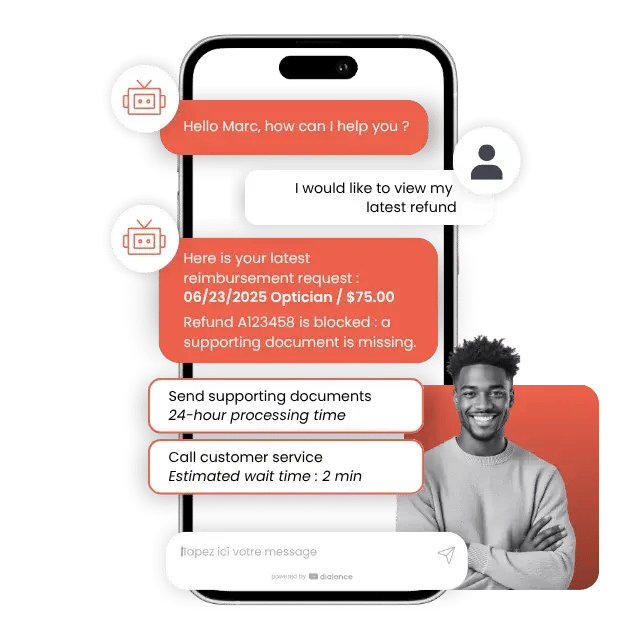
Artificial intelligence agents have three main characteristics:

Autonomy: they can operate without human intervention, make decisions, and perform tasks independently. Although they receive initial instructions, they determine for themselves the best way to accomplish a mission, which makes them particularly effective at managing complex processes in real time.

Continuous learning: thanks to feedback whether from advisors or their environment, these agents continuously improve. They adapt their behavior based on the results they obtain, allowing them to evolve and make increasingly accurate decisions over time.

Reactivity and proactivity: they are capable of responding to environmental changes in real time (responsiveness) while anticipating trends and recurring events to optimize their performance (proactivity). For example, an AI agent in customer service can analyze and categorize the reasons users contact the service, instantly answer frequently asked questions, and escalate complex requests to a human agent, all while anticipating customer needs by analyzing past interactions.

Understanding the difference between an AI agent and agentic AI

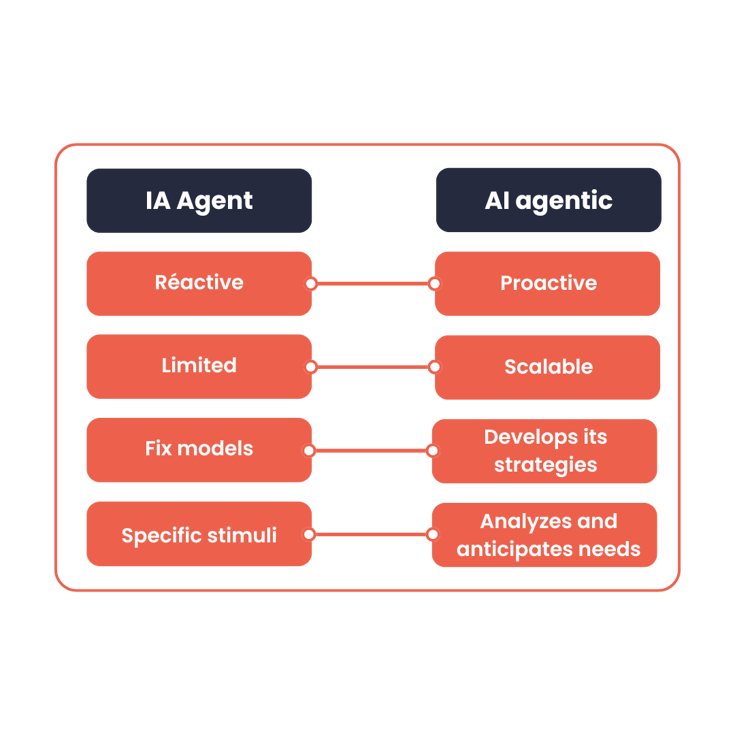
The difference between an AI agent and agentic AI

The concept of agentic AI emerged at the same time as the concept of an AI agent. However, the two differ fundamentally in their degree of autonomy and their ability to take initiative. An AI agent often operates within a more regulated and controlled framework, where its actions are directly influenced by the person using it. In contrast, an agentic AI possesses a higher degree of autonomy and can make more decisions on its own. It is designed to learn, adapt, and optimize its actions without constant human intervention. In other words, an AI agent is an intelligent executor, while agent-based AI is more akin to a strategic system capable of planning and anticipating its own actions.
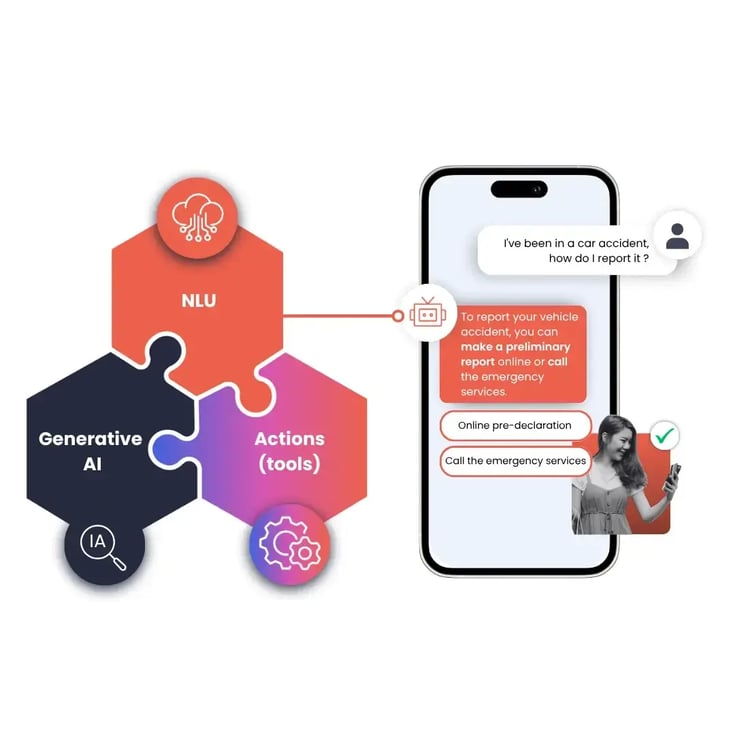
L’agent IA de DialOnce combine un NLU avancé et un référentiel propriétaire d’intentions pour qualifier en temps réel les demandes complexes des clients et les orienter sans rupture vers le bon parcours.

The difference between an AI agent and an AI chatbot

The terms "AI agent" and "AI chatbot" are often confused, even though they refer to distinct concepts in the field of artificial intelligence. An AI chatbot is a program designed primarily to interact with users via text or voice interfaces, answering questions or performing simple tasks based on predefined scenarios (these are also referred to as pre-configured or scripted chatbots).

In contrast, an AI agent is a more advanced and specialized entity that can understand, reason, and act autonomously based on its environment. It uses data and information to achieve specific objectives, such as responding to customer requests in the context of after-sales support. These agents use advanced technologies, such as machine learning and natural language processing, to continuously improve and adapt to user preferences. A chatbot, on the other hand, is generally used to answer questions and provide basic information. Its role is limited to exchanging information; it lacks the ability to perform actions or make complex decisions.
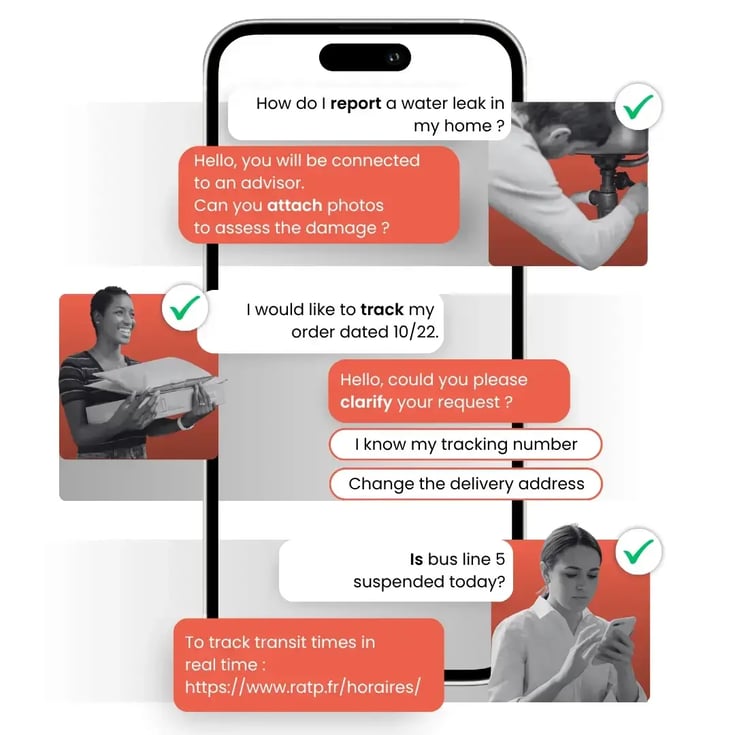
Beyond chatbots. An AI agent that really works!

This confusion between AI agents and AI chatbots stems largely from the rapid evolution of technology and the interchangeable use of these terms in marketing and communications. Indeed, with the emergence of increasingly powerful artificial intelligence solutions, the line between chatbots and AI agents is becoming increasingly blurred. Advances in natural language processing and deep learning have thus enabled chatbots to offer richer and more engaging interactions similar to those of AI agents further fueling this confusion.


How does an AI agent work?

To function effectively, an AI agent relies on several essential elements:
Perception: when a customer makes a request, the AI agent captures and analyzes the information to respond effectively. This perception relies on physical sensors (microphones, cameras) and virtual sensors (APIs, knowledge bases). Physical sensors enable speech recognition and image analysis, while virtual sensors access databases and online resources to enhance understanding of the requests. In customer relations, this perception is essential for identifying the customer’s intent, analyzing data, and providing a tailored response, ensuring a smooth and effective interaction. This is the strength of NLU (Natural Language Understanding), which enables the accurate understanding and interpretation of requests for an optimal response.

Processing and reasoning: it analyzes this data using machine learning algorithms, symbolic logic, or other approaches such as Retrieval-Augmented Generation (RAG). This processing may include extracting information from a knowledge base, pattern recognition, and decision-making based on probabilities or predefined rules.

Action: based on its analysis, the agent performs an action, such as answering a question or adjusting system settings. For example, it can modify a customer’s subscription based on their needs or update communication preferences for personalized support. These actions can be simple, such as generating text, or more complex, such as automatically creating a ticket in the ERP system when a customer reports an issue, and assigning the request to the appropriate department for prompt resolution.

Learning and Adaptation: using deep learning or reinforcement learning techniques, the agent improves its performance over time. It can adjust its responses based on user feedback, refine its predictive models, or even learn new tasks from previously unseen data.

The different types of AI agents

There are several types of agents, distinguished by their degree of autonomy and sophistication:
Reactive agents: these respond in real time to customer requests without maintaining a history. They are ideal for services requiring immediate assistance, such as customer support chatbots handling frequently asked questions or automated response systems. Their speed of execution ensures seamless, 24/7 service, reducing wait times and improving customer satisfaction.

Model-based agents: these agents use an internal model to anticipate the consequences of their actions. Examples: advanced chatbots. Unlike reactive agents, these agents store and use historical data to refine their decisions and optimize their responses, making them ideal for voice assistants or customer service platforms.

Goal-based agents: they plan their actions based on a defined goal, optimizing their decisions. These agents are capable of making strategic decisions by evaluating multiple scenarios and adjusting their behavior based on the results obtained. They are commonly found in customer service, where they operate based on tests and measurable objectives. They evaluate past interactions, perform predictive analytics, and dynamically adjust their strategies based on the results obtained.

Self-learning agents: they adjust their behavior based on feedback, such as Google DeepMind’s AI. Thanks to machine learning and deep neural networks, these agents continuously improve their performance and can outperform expert advisors in their field on complex tasks, such as AI-assisted medical analysis, autonomous drone piloting, and advanced industrial robotics.

Use case showing how DialOnce’s AI agent improves support quality with real time responses intuitive journeys omnichannel orchestration and secure AI.

The main use cases of an AI agent

1. Improved customer service

One of the most common uses of AI agents is customer service utomation. These agents provide instant responses to inquiries 24/7 and can handle a large volume of requests simultaneously. They handle frequently asked questions, direct customers to the right departments, and identify situations that require a human agent’s intervention. The result: improved customer satisfaction and a reduced workload for support teams.

2. Optimizing lead generation

An AI agent isn’t limited to managing customer interactions. It’s also an excellent tool for lead generation. By analyzing visitor behavior on a website and interacting with them, it automatically qualifies leads, can schedule an appointment, or transfer leads to sales representatives while providing context with precise information about their needs.

3. Managing Peak Workloads

In certain sectors such as e-commerce, public services, or ticketing, spikes in demand can overwhelm teams. AI agents handle this volume by providing instant responses and automating certain tasks, such as order tracking, updating availability, or managing complaints. This helps streamline interactions and prevent frustration caused by long wait times.

Visual IVR meets customer expectations for speed and simplicity while preserving the human connection through the phone channel.

Why integrate an AI agent into your customer service?

The AI agent (next-generation AI chatbot) is revolutionizing customer service by combining automation and personalization. Unlike traditional AI systems, these intelligent agents connect to the brand’s ecosystem and IT systems to tailor their responses based on the context and the customer’s profile, thereby offering a personalized interaction. Through proactive support, they anticipate customer needs, reduce complaints, and optimize satisfaction. Their omnichannel capability ensures continuity across different touchpoints.

By analyzing data in real time, the AI agent identifies and resolves issues before they become critical, ensuring intelligent emergency management and a personalized customer experience. It also automates complex processes, thereby reducing wait times and improving the efficiency of interactions. For example, an AI agent can handle thousands of conversations simultaneously, while tailoring its responses to the tone and specific needs of each user.
In addition, the AI agent strengthens customer loyalty by offering proactive solutions tailored to consumer expectations. It analyzes past behavior to anticipate requests and provide relevant recommendations, thereby transforming customer support into a true strategic asset. By integrating this technology, companies can not only improve their operational efficiency but also strengthen their relationships with customers, ensuring a service that is increasingly effective and tailored to modern expectations.

At DialOnce, we’ve seen a 25% increase in customer satisfaction among our clients.


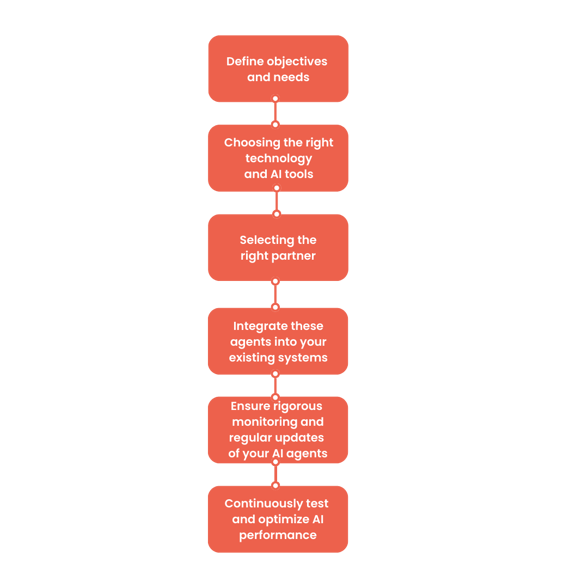
The 6 steps to deploying an AI agent

To implement AI agents effectively, it is essential to follow five key steps. A structured and well-thought-out implementation not only improves operational efficiency but also ensures a smooth transition to automation.

Key steps to deploy an AI agent with DialOnce


Clearly define your company’s objectives and needs in order to identify the processes that should be automated. It is crucial to identify tasks that are repetitive, time-consuming, or require strong analytical skills to maximize the impact of AI.

Choose the most suitable AI technology and tools by evaluating the various available platforms and selecting those that meet your needs and integrate best with your technology ecosystem (CRM, CCaaS...).

Select the right partner with expertise in data science, fine-tuning AI models, and integrating AI solutions tailored to business needs. This partner must be able to optimize agent performance by precisely adjusting prompts and leveraging advanced machine learning techniques. Furthermore, it is essential that they have genuine business experience, particularly in customer relations, to design interactions that are appropriate, effective, and personalized. They should also support your company during the AI training phase, ensuring continuous improvement and skill development for your internal teams.

Integrate these agents into your existing systems while ensuring optimal interoperability with your IT systems and databases. Seamless integration ensures that processes remain uninterrupted and that the AI can work in synergy with your existing tools.

Continuously test and optimize the performance of your artificial intelligence by analyzing user feedback and collected data. Regular adjustments are necessary to refine the accuracy of responses (for example, updating the knowledge base), improve the user experience, and maximize added value.


Ensure rigorous monitoring and regular updates of your AI agents to maximize their effectiveness and relevance. Technology is evolving rapidly, so it is essential to adapt and modernize AI models in line with new trends and user feedback.


By methodically applying these six steps, you’ll ensure a successful and sustainable implementation of your solutions. A gradual and well-planned adoption ensures a seamless transition to intelligent and high-performance automation.


The risks and limitations of AI agents

One of the key aspects of the proper use of AI agents involves the collection and processing of personal data. These systems enable the efficient management of information such as names, addresses, banking details, and medical records. However, to ensure their security, it is essential to apply best practices for data management and protection. Regulations such as the GDPR and the AI Act provide a framework to ensure optimal transparency and compliance. By integrating advanced security protocols and training teams, it is possible to fully harness the potential of AI while ensuring responsible and secure use of data.

Automating customer interactions with AI should not be viewed as a cause for concern, but rather as a valuable tool in day-to-day operations. By taking on repetitive, low-value-added tasks, these technologies allow customer service representatives to focus fully on the essence of their job: building customer relationships and solving complex problems. For successful integration, it is essential to view these tools as strategic allies and to train teams to collaborate effectively with the AI agent.

Artificial intelligence models (LLMs), while powerful, can generate incorrect or inconsistent responses, a phenomenon known as “hallucination.” Furthermore, these models often operate as “black boxes,” making it difficult to understand the decisions they make. This lack of transparency can pose challenges in terms of accountability and regulatory compliance. To minimize these risks, it is essential to implement human validation mechanisms and integrate trustworthy AI. The LLM-as-a-Judge agent supervises and then validates the responses from AI systems, ensuring more reliable decision-making. This quality control improves the traceability of decisions and enables the use of explainable models to ensure a safer and more ethical use of AI agents.


The future of AI agents

The future of AI agents is moving toward greater autonomy, real-time adaptability, and better integration into business processes. The emergence of hybrid AI, combining logical reasoning and deep learning, could reduce bias and improve explainability.

As AI evolves, multi-agent systems are gaining importance. These systems enable multiple AI agents to collaborate in real time, exchanging information and optimizing processes to deliver more sophisticated, adaptive, and efficient solutions capable of handling complex interactions and proactively improving the user experience.

Collaboration between AI and customer service representatives is expected to intensify, transforming these tools into true augmented assistants rather than mere automated systems. AI agents will become more customizable, adapting to users’ preferences and habits to provide a more seamless and effective interaction. Advances in emotional AI will also enhance the user experience by incorporating greater empathy and contextual understanding.

To anticipate these developments, companies must prioritize flexible and scalable solutions, invest in ongoing training for customer service representatives, and ensure that their AI adheres to strict ethical and regulatory standards in order to reap its full benefits. A proactive approach, combining innovation and vigilance, will ensure a smooth adoption process and continuous improvement in the performance of AI agents.


Integrating an AI agent represents a major strategic asset for companies seeking to improve their customer relationships while optimizing their internal resources. By combining autonomy, continuous learning, and adaptability, these agents provide instant, personalized, and effective assistance. Their implementation requires rigorous planning, adaptation to the company’s needs, and constant monitoring to ensure their long-term effectiveness. In a world where customer experience is a key factor in customer loyalty, AI agents have emerged as an essential solution for meeting the demands for speed and personalization in customer interactions.